

This guide prices the job the way an owner has to price one: the range first, then the variables that move it, then what gets added to the bill, and finally what a fair quote should contain before you sign it.

How much should an HVAC company spend on marketing in 2026?
As ACCA notes, plan on 5% to 15% of revenue, and expect the survey average for HVACR contractors to sit near 6%. That average describes what contractors actually spent, not what any one company should spend next year.
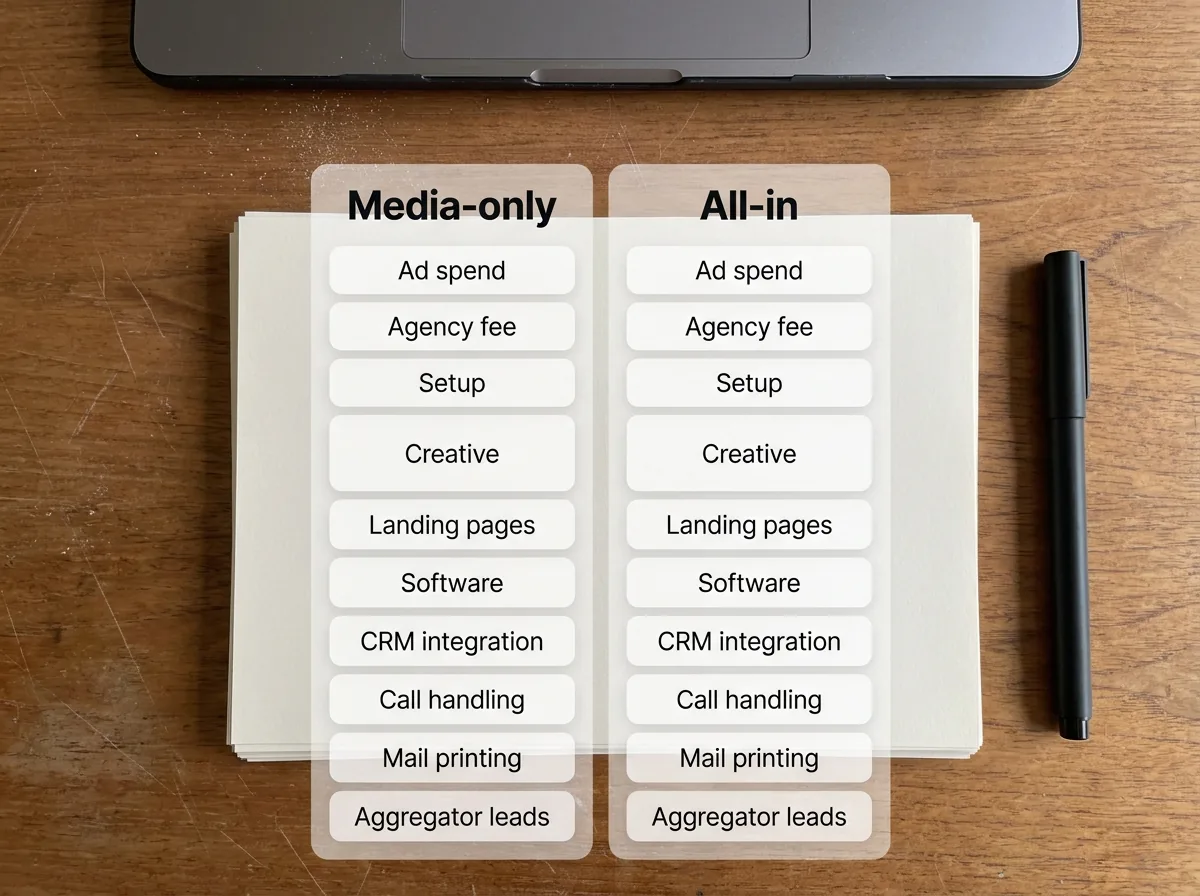
Here’s where people get stuck. Published percentages almost never say what is inside the number. Some count media only (the money that goes to Google, Meta, a mail house or a radio group). Others count total marketing spend, which adds agency fees, software, creative, photography, truck wraps and CSR training. A 6% media-only budget and a 6% all-in budget are two different companies. Decide which definition you are using before you compare yourself to anyone.
How much should HVAC marketing cost based on revenue?
Revenue-based planning ranges tighten as a company gets bigger, because a $6 million contractor is spending against a base that already produces repeat calls and referrals. Below is the guidance published for HVAC and small business planning, with the definition each figure usually carries.
| Company stage or goal | Published planning range | Usually counted as |
|---|---|---|
| Under $1M revenue | 10% to 15% of revenue | Total marketing spend |
| $1M to $3M revenue | 8% to 12% of revenue | Total marketing spend |
| Above $3M revenue | 5% to 8% of revenue | Total marketing spend |
| Holding position, no growth target | About 5% | Media-weighted |
| Active growth | 8% to 12% | Total marketing spend |
| Published HVAC budget guidance often recommends percentage-based allocations that vary by revenue level, check the specific source for the exact brackets. |
One published HVAC source describes a typical revenue allocation and says a large share may go to digital channels. Whichever percentage you pick, the same categories share it: the website, SEO, Google Search Ads, paid social, and offline media like radio or local TV. For a comparator only, cross-industry CMO surveys report 7.7% and 9.4% of revenue, pooling software companies with retailers.
The percentage tells you the ceiling you can afford. It never tells you the budget the work actually requires.
How much should HVAC marketing cost based on target installs?
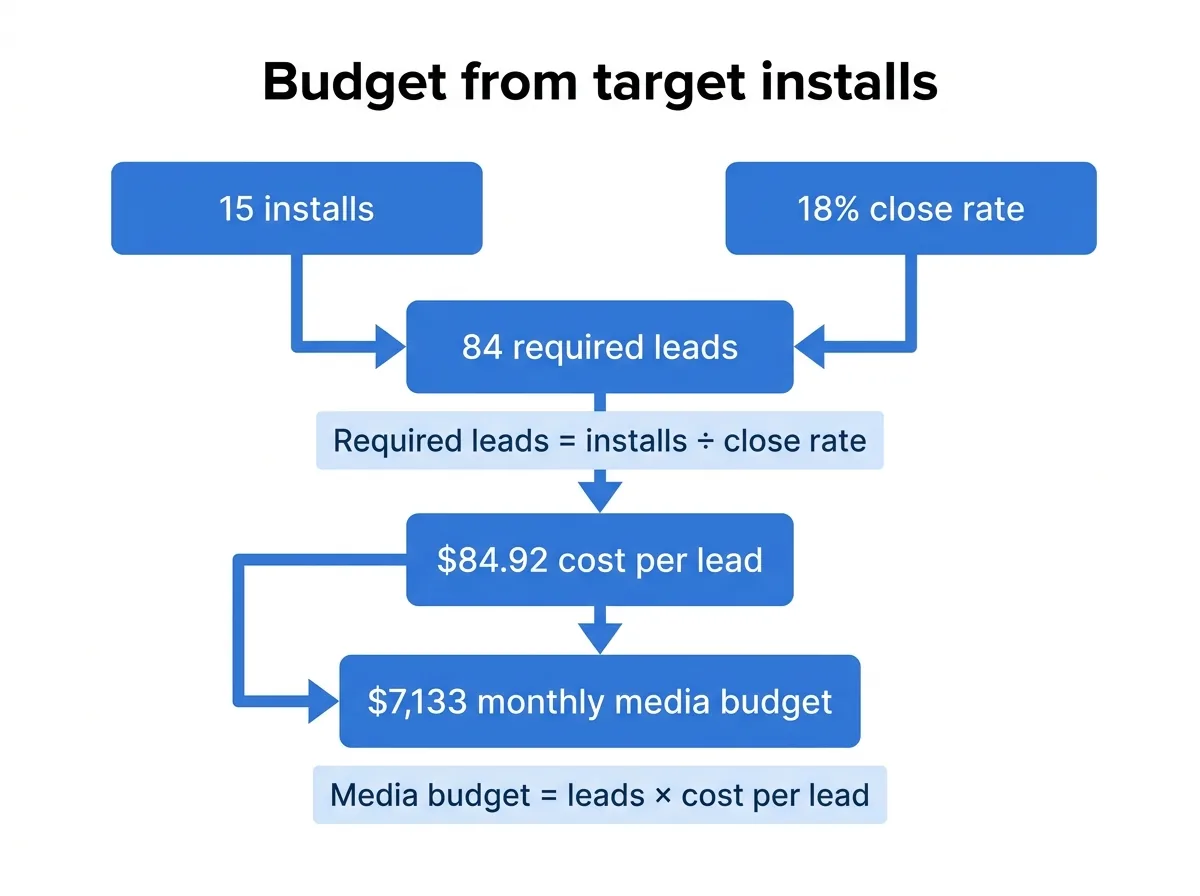
Budget from the jobs you want, then check the percentage afterward. The math runs in two steps:
- Required leads = target sold jobs divided by your lead-to-sold close rate
- Monthly media budget = required leads multiplied by cost per lead
Here is the worked version. Say you want 15 additional installs a month. As Pipelineon notes, in a 2025 home services benchmark covering 3,211 campaigns, HVAC Google Ads averaged $84.92 per lead. Use your own trailing close rate from the CRM, not a published one. At an 18% lead-to-sold rate, 15 installs need about 84 leads. At $84.92 a lead that comes to roughly $7,133 a month in media, before fees and creative.
Two checks before you approve that number. First, swap in your real close rate. A five-point swing moves the budget by more than a thousand dollars. Second, run the capacity check: 15 extra installs means crew days, equipment on hand and a dispatcher who can quote them inside 48 hours. If the install board is already full three weeks out, the money buys cancellations, not revenue. Fund the crew first, then the ads.
What a $5,000, $25,000, $100,000, and $200,000 HVAC marketing budget can buy
Budget size decides scope. Sourced benchmarks do not support one channel split for every tier, so read the table as what each budget can carry well, what it can track, and what it can test.
| Monthly budget | Scope it can carry | Tracking and testing |
|---|---|---|
| $5,000 | One or two demand-capture roles done properly, aimed at homeowners who need a tech today | Call tracking and one clean CRM lead source, with no room for a holdout test |
| $25,000 | Capture plus a slower-payback role such as local SEO and content, with one paid test running | Booked-job reporting by source, one test at a time |
| $100,000 | Capture, organic and brand roles together, with aggregator or mail spend judged on booked-job cost | Geographic holdouts, offline conversion import, monthly cohort reporting |
| $200,000 | Multi-market or multi-branch pacing, brand media at real frequency, dedicated creative production | Branch-level attribution, incrementality tests, media mix review |
Two rules travel with every tier. A small budget should buy demand that is already in the market, because that money has to come back inside the month. A large budget can fund demand that pays back over months, like brand media that lifts branded search and direct calls even when attribution is imperfect. Every tier sets aside money for creative, tracking, CRM work and call handling before the media number gets fixed.
What drives HVAC marketing costs up or down?
Before a benchmark means anything, name the unit. A raw lead is any call or form, wrong numbers and duplicates included. A booked call is a lead that took a slot on the schedule. A sold job is the one that got installed and invoiced. Published HVAC lead prices swing by several times mostly because those three units get reported under the same word.
Contractor Magazine reports that High-intent search leads were reported at $30 to $90 per lead in 2026. Neither figure is a cost per sold install. Channel-by-channel numbers belong to the companion article on HVAC marketing benchmarks.
Four drivers move your own number more than the channel you pick: season, competition, service radius and crew capacity.
| Cost driver | Moves cost up | Moves cost down |
|---|---|---|
| Season | Peak heat and first freeze, when every contractor bids at once | Spring and fall shoulder weeks |
| Competition | Dense metro with national brands in the auction | Suburban service area with fewer bidders |
| Service radius | Wide radius, long drive times, thin route density | Tight radius where the truck roll is short |
| Crew capacity | Full board, slow callbacks, bookings lost to the next contractor | Open capacity and same-day quotes |
| Unit counted | Sold job | Raw lead |
| Job type | Replacement and heating install leads | Repair and maintenance calls |
Capacity is the driver owners skip. Leads you cannot book raise cost per sold job while cost per lead sits still. That is how a channel looks cheap and still loses money.
What gets added to the bill besides ad spend?
The media is the visible half. The rest of the bill is the part owners find out about in month two.
- Agency management fee, flat or percentage of spend, billed separately from media. What that fee normally covers is broken down in the article on HVAC marketing agency pricing.
- Setup or onboarding fee, charged once, sometimes a full extra month.
- Creative and production: photos of your trucks and techs, video, offer design, print artwork.
- Landing pages and website work, including hosting, forms and page speed fixes.
- Software: call tracking numbers, rank tracking, form software, CRM seats.
- CRM integration work so lead source is captured once and stays clean.
- Call handling: after-hours answering, overflow coverage, CSR scripting and training.
- Printing and postage on any mail, which is a media cost that arrives as a separate invoice.
- Aggregator lead spend, often $5,000 to $15,000 a year for an active HVAC company, billed by the platform.
Write the media-only total and the all-in total on the same page. That single comparison is what makes a percentage of revenue mean anything.
How can an HVAC company pay less without regret?
Cost per booked call beats cost per lead, because a booked call is the first number that touches your schedule. The savings that hold up all come from measuring further down the funnel instead of spending less at the top.
- Fix source hygiene first. One clean lead source field in the CRM, tied to call recordings, usually exposes a channel producing duplicates, out-of-area calls or wrong numbers that nobody had costed.
- Reprice every channel on cost per booked job. The channel with the cheaper lead can cost more once the book rate is in the math. Divide spend by booked jobs and rank the list again.
- Tighten the geography. Pull booked jobs, average ticket and drive distance by ZIP code, then cut the outer areas where the ticket does not cover the truck roll.
- Pace by season instead of by twelfths. Spend into the peak while the crews have room, and pull back in the shoulder weeks.
- Judge a cheap click by what it closed. At Precision Patch Pros, a drywall company in Bakersfield on our Starter plan, the first paid click after the February 2026 Google Ads rebuild cost $1.94. That lead closed the next day for $2,915. The click price was never the point.
The cuts that backfire are predictable: turning off branded search, pausing a channel mid-test before it has enough conversions to read, and chasing the cheapest aggregator lead into out-of-area, low-margin work. If you want a read on where your spend is leaking before you change anything, ask for a look at your current numbers and we will tell you what we see.
What does a fair HVAC marketing quote look like?
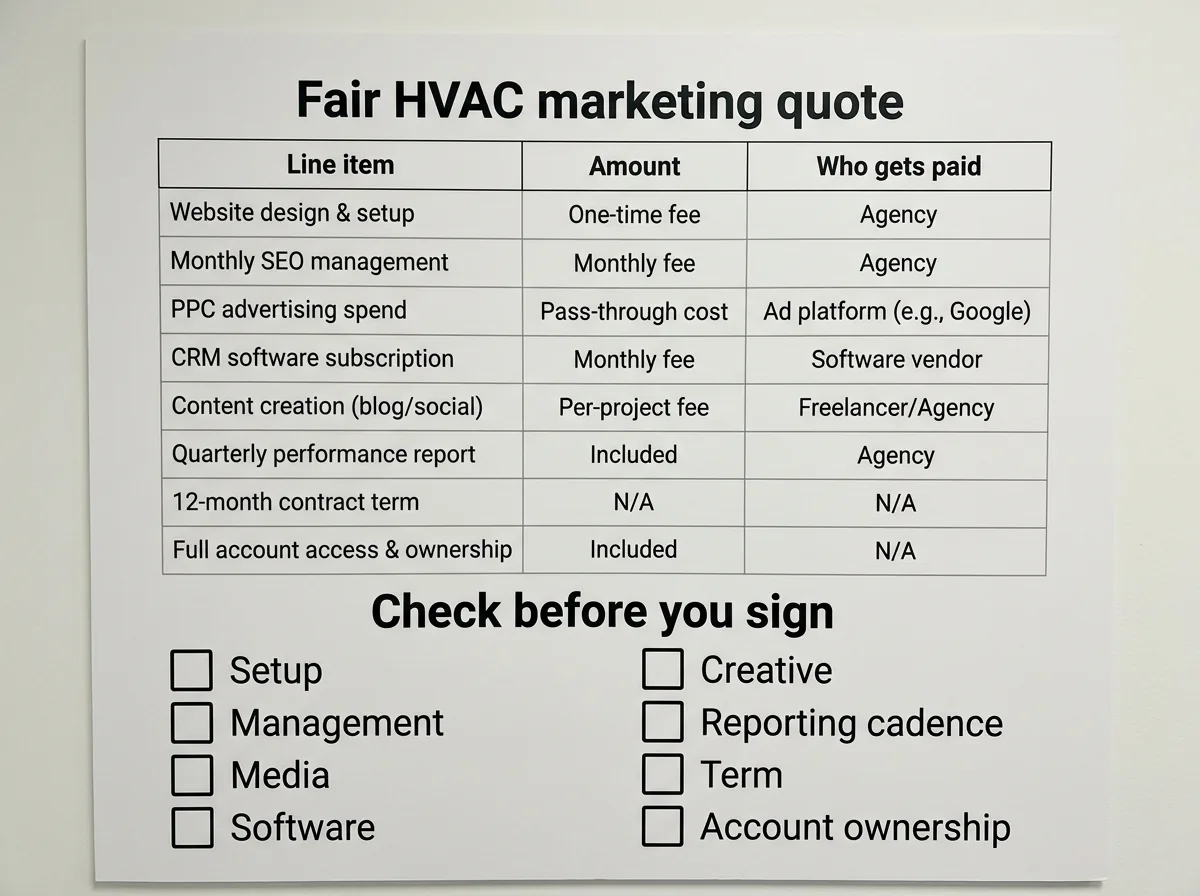
A fair quote separates money that goes to a platform from money that goes to the agency, and states how results get measured.
Quote example
| Line item | Amount | Who gets paid |
|---|---|---|
| Setup or onboarding | $0 to one-time fee, stated | Agency |
| Monthly management | Flat fee or stated percentage | Agency |
| Media spend (Google, Meta) | Your number, billed by the platform | Google, Meta |
| Software (call tracking, rank tracking) | Stated monthly | Vendor or agency |
| Creative and landing pages | Included or quoted per item | Agency |
| Reporting | Cadence stated, not “as needed” | Agency |
| Term and cancellation | Month to month or stated length | Contract |
| Account ownership | Your accounts, your data, your number | You |
Check eight lines before you sign: setup, management fee, media, software, creative, reporting cadence, term and cancellation, and account ownership. Ask whether the media carries a markup, and ask what happens to the ad accounts and the call tracking numbers on the day you leave. On our plans there is no setup fee, ad spend is paid directly and never marked up, the client owns every account, and every plan gets a weekly written report and a monthly strategy call with Ben. SEO pricing structures get their own treatment in the article on how much local SEO costs.
When does DIY HVAC marketing save money, and when does it cost more?
Owners handle parts of this well: Google Business Profile posts and photos, review requests after every completed job, the maintenance plan email to past customers, and picking up the phone faster than the competition does. Those cost time instead of media, and they raise the return on every dollar of spend.
The cost flips in three places. Unmanaged paid search drifts into broad-match waste within weeks. Half-built tracking produces reports nobody trusts. And peak season is exactly when the owner has no hours left to watch an ad account. As a rough rule of thumb, under about $2,000 a month in media, self-managing often nets out ahead. Above that the wasted spend usually runs past the fee.
Want a second opinion on the budget you are running now? Send us your numbers and we will show you where the booked jobs are actually coming from.
Frequently Asked Questions
How much should I spend if I only want 10 more replacement jobs?
Multiply 10 by your allowable cost per booked job, which is the slice of gross profit on an install you are willing to give up to win it. If that allowance is $300, the media number for the month is about $3,000. Check the install board before you turn anything on. Ten extra units means crew days, equipment on hand and quotes going out inside 48 hours.
Is a $500 to $1,500 Google Ads budget enough for an HVAC company?
It buys clicks more often than it buys data. At the $53 average cost per lead reported across 888 contractors and 126,650 leads in a February 2026 home services benchmark, $1,000 a month yields roughly 19 leads. That is thin for reading a trend or optimizing a campaign. Set a stop or go rule before you start: fund the channel properly, or move the money to Google Business Profile and past-customer work until you can.
Should HVAC companies budget from current revenue or target revenue?
Budget from target jobs and use current revenue as the affordability check. In a flat year the two answers usually agree. In a growth year the job math asks for more than the percentage allows, which leaves you a smaller goal or a bigger allowance. A company opening a new service area or chasing commercial agreements should expect to run above the survey averages for a while.
How do you calculate HVAC customer acquisition cost from call tracking and CRM data?
Take total marketing spend for the period, fees and software included, and divide it by the sold jobs the CRM attributes to marketing in that same period. It only works when every call and form writes one lead source into the CRM and the job record carries that source through to close. If the feedback stops at calls and forms, you are counting contacts rather than customers.
Are HVAC lead aggregators cheaper than generating leads through Google?
On nominal cost per lead they often look cheaper. On cost per booked job they frequently are not, because leads may be shared, duplicated or outside your profitable radius. Price them by booked job and by average ticket, not by the platform’s dashboard. The full verdict lives in the article on Angi leads.
How should commercial HVAC marketing budgets differ from residential repair budgets?
Commercial sales cycles run months, so the budget shifts from high-volume capture toward fewer, higher-value targets: service agreement outreach, a strong site for rooftop and controls searches, and direct contact with property managers. Cost per lead rises and volume falls. That is fine when one service agreement is worth years of revenue. Judge it on pipeline value, not on monthly lead count.
What is the 70/20/10 rule in marketing?
It splits spend into 70% on what reliably works, 20% on proven channels you are scaling, and 10% on experiments. For an HVAC company that usually means search and Google Business Profile in the 70, SEO or mail in the 20, and one test channel in the 10. It only holds up when you can measure the 70 well enough to know it is working.
What is the 60/40 rule in marketing?
It suggests 60% of spend toward brand building and 40% toward direct response. Most HVAC companies under $3 million should invert it, because capture channels pay back inside the month and brand media needs scale to register. The 60/40 idea earns its keep at higher budgets where radio, CTV and mail can run at real frequency.
How much should a bigger service radius change my budget?
A wider radius raises spend, since you are bidding in more auctions, and it can lower margin through drive time. It pays off only when the outer areas carry tickets large enough to cover the truck roll. That makes it easier to defend for replacement work than for low-ticket repair calls. Set that minimum ticket by area first, then let 90 days of booked-job data decide which ZIP codes stay on.
Researched and written with Sure Shot Cited, the AI article writer we built for our own client work, then reviewed by Ben Desjardins before it went live.