


Agencies that publish service-city pages usually start looking for local falcon alternatives once client count and grid sizes grow together, and the right replacement depends on why they are leaving. Vendor prices and features below were checked on each vendor’s own site as of September 2026.

Why agencies leave Local Falcon when they track many service-city pages
Agencies outgrow Local Falcon for three reasons: the bill gets hard to forecast, clients ask about organic page rankings as well as Maps, and reports eat account manager hours.
The bill moves with grid size. Local Falcon defines a credit as one data point, or “map pin,” on the geo-grid, so every step up in grid size multiplies what each keyword costs. A fixed retainer has to absorb that swing.
A heatmap measures Maps, not your pages. A geo-grid shows where the Google Business Profile appears in map results from a set of points. It does not show whether /drain-cleaning-{city}/ ranks organically for “drain cleaning {city}”, which is what clients buying service-city pages ask.
Reports still need a human pass. Someone has to turn scans into a report that says what changed and what to do next, for every client.
The short list: Local Falcon alternatives and who each fits
Disclosure: we make one of these tools, the Sure Shot Local Rank Tracker. The other options are described from their own official pages.
| Tool | Best for | Starting price (as of September 2026) | Main tradeoff |
|---|---|---|---|
| Sure Shot Local Rank Tracker | A finished weekly report with next actions | Solo $99 a month per business; Agency $499 a month for 5 client slots (Sure Shot) | Priced per business, so mass prospect audits cost more |
| BrightLocal | Rankings, grids and AI visibility in one plan | Track plan from $31 a month (BrightLocal) | Multi-location price is quoted by location count |
| Local Viking | Agencies that sell Google Business Profile management | Not published | GBP tools you may not need for rank data |
| Whitespark | Low-cost organic and local pack tracking | Local Rank Tracker from $14 a month, billed annually (Whitespark) | Grids are a separate product and bill |
| Local Dominator | A direct grid swap with cheaper scan shapes | From $32.50 a month (Local Dominator) | Still a credit bill to forecast |
| Local Falcon (stay) | Large grids, exports and API access | Starter $24.99 a month for 7,500 credits (Local Falcon) | A credit budget to manage per client |
Sure Shot Systems Local Rank Tracker
Best for: agencies that sell reporting as part of the retainer.
Our tracker is built around the weekly report. Per the Sure Shot Local Rank Tracker page, each report maps every service page in every city served by organic position, names the top 3 map pack businesses at each grid point, and shows whether Google’s AI Overviews and AI Mode cite you or a competitor.
What it does better than Local Falcon: no credits, since the plan pays for a schedule that runs every grid point every cycle. Each report ends with three prioritized tasks, such as a page at position 6 that needs one internal link, and the next report measures whether the targeted keywords moved. Agency reports carry your logo and sender domain. If 60 days of completed tasks move nothing, the Prove-It Guarantee refunds those 60 days.
The catch: the schedule is fixed, so there is no scan balance for ad-hoc pitch grids.
BrightLocal
Best for: agencies that want most local SEO work in one login.
BrightLocal’s pricing page lists Local Rank Tracker for “up to 100 keywords and four competitors per location,” with the Local Search Grid, the Local AI Visibility Tracker and white-labelling included in all three plans (Track, Manage and Grow). The tracker covers Local Pack, Organic and Map results in Google and Bing (BrightLocal).
What it does better than Local Falcon: the grid is part of the plan, so a wider grid does not raise a credit bill. The catch is grid size. BrightLocal’s grid page goes up to 15×15, so a wide rural service area gets coarser coverage than a larger Local Falcon grid.

Local Viking
Best for: teams that post, edit and answer reviews on client profiles every week.
Local Viking lets you “create new posts for all of your GMB properties from a single dashboard,” schedule photos, edit listings, manage reviews and run GeoGrid visibility tracking “powered by the Google Places API.”
What it does better than Local Falcon: whoever writes the GBP post sees the grid it is meant to move. The catch is clarity: as of September 2026 its sign-up buttons open a Local Optics account page (app.localoptics.com) with no explanation, and organic URL tracking is not described, so get terms in writing and test one client first.
Whitespark
Best for: smaller agencies watching many city pages on a tight budget.
Whitespark’s Local Rank Tracker tracks “Local Packs, Maps, and organic results in Google and Bing on both desktop and mobile,” and client reports go out as a password-protected link on your own domain.
What it does better than Local Falcon: plans are sized by location keywords (100 on Small Business up to 1,000 on Agency) with unlimited locations, so adding a client’s new service area uses keywords, not credits. The catch is on the grid side: Local Ranking Grids charges one credit per grid point, and “unused credits expire after each billing period,” so a slow month still burns the budget.
Local Dominator
Best for: grid-first agencies coming straight from Local Falcon.
Local Dominator also charges one credit per scan point, but it offers circle scans: a 9×9 circle uses 64 credits where a 9×9 square uses 81, and the scan it calls most common, a 13×13 circle over one mile, uses 133.
What it does better than Local Falcon: the circle shape cuts about a fifth of the credits for the same grid width, and scans can recur with white-labeled reports. The catch: Maps and Local Pack are separate trackers, and checking both “will trigger two simultaneous scans for every point on the grid” (Local Dominator).
Staying with Local Falcon, done better
Stay when clients buy geo-grid visibility and your problem is the forecast. Local Falcon offers grids from 3×3 to 21×21, CSV and PDF exports on all plans, and API access from the Basic monthly package. Three changes usually fix the forecast:
- Split scan sizes by purpose. Run a 5×5 grid (25 points) weekly for trend lines and save the 13×13 (169 points) for the monthly client report.
- Set one grid standard per client tier. Write down the grid size each retainer level gets, so nobody widens a grid for one client without a price change.
- Move organic tracking elsewhere. Put service-city URL tracking in a keyword-based tracker and keep Local Falcon on Maps.
How to track service-city pages across many locations
Give every service-city page two measurements, organic and Maps, from one keyword-to-URL matrix.
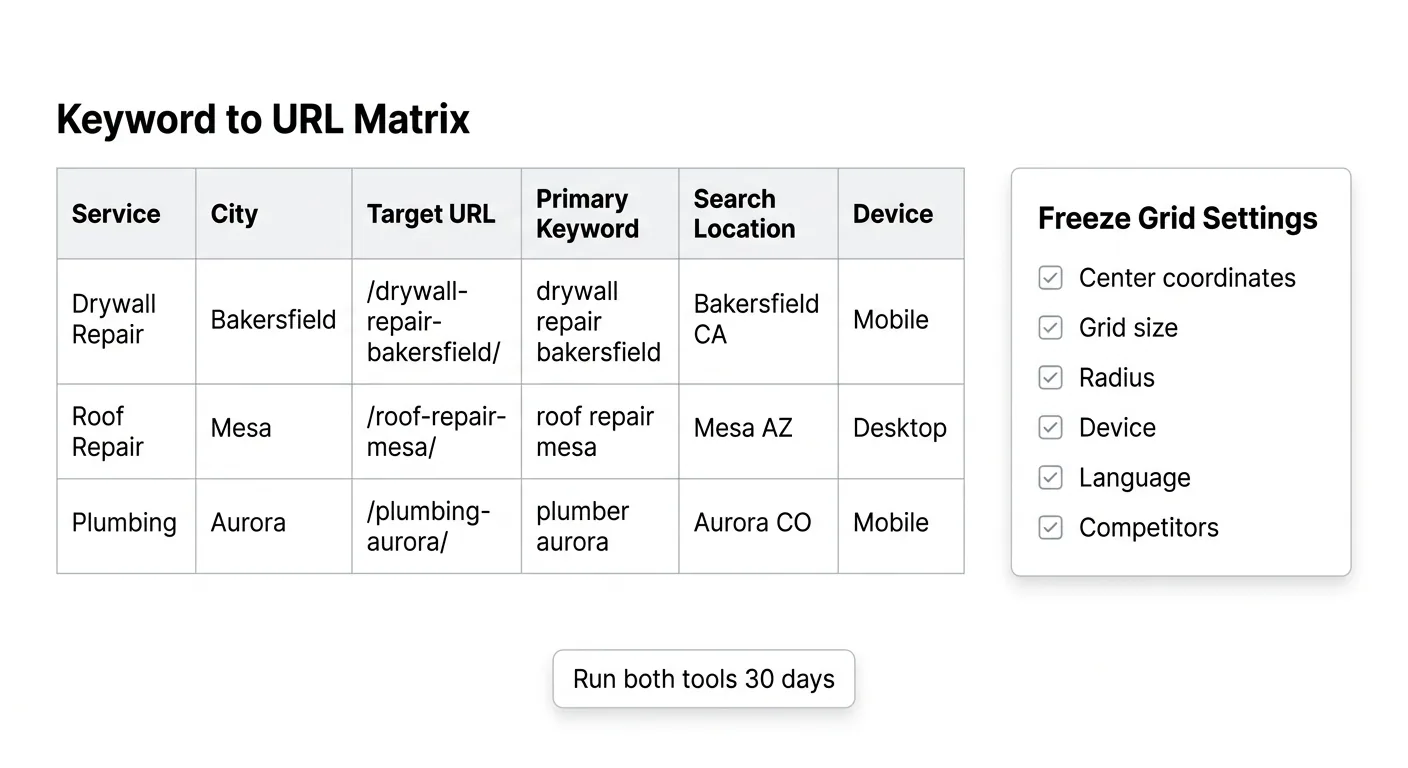
- Build the matrix first. One row per page. For example: service “drain cleaning”, city {city}, URL /drain-cleaning-{city}/, keyword “drain cleaning {city}”, search location {city} center, device mobile.
- Track the organic URL along with the position. Flag any week a different city page ranks for that keyword, since that is where cannibalization shows up.
- Track Maps from grid points. The same row can show organic position 3 and no map pack presence on the far side of town.
- Read weak edge cells as distance. Google says local results “are mainly based on relevance, distance, and popularity” (Google Business Profile Help). A service-area business with no address in {city} will show empty outer cells, and new content will not fix distance.
To see both measurements in one weekly report for a client of yours, the Sure Shot Local Rank Tracker can start on a single account.
What local rank tracking costs at agency scale
A credit bill is clients times keywords times grid points times scans. For example, using Local Falcon’s packages: 10 clients with 5 keywords each on a 7×7 grid (49 points), scanned four times a month, use 9,800 credits, which fits Basic at $49.99 a month (15,150 credits). Widen the grid to 11×11 (121 points) and the same work needs 24,200 credits, which means Pro at $99.99 (31,250 credits). One grid decision doubled the bill.
Flat plans move the variable from credits to clients. Sure Shot’s Pro plan is $249 a month per business for up to 600 real grid searches a week, month to month (Sure Shot). The full Local Falcon package math is in “local falcon pricing”.
Mistakes to avoid when switching local rank trackers
Doing the switch in this order avoids most first-month damage.
- Export before you touch billing. Pull CSV and PDF history for every client; history rarely transfers between vendors.
- Rebuild specs, not client names. Load the keyword-to-URL matrix with the old tool’s center point, grid size, radius, device, language and competitor set. A 7×7 grid at a 2-mile radius and a 5×5 at 5 miles are different tests, and mixing them produces a gain or “drop” that never happened.
- Run both tools for 30 days. Overlap on the same clients separates real ranking changes from differences in how two tools measure. Cancel the old tool only after the overlap ends.

Which Local Falcon alternative should you pick?
Start from what the client pays you to report:
- A Maps heatmap: keep Local Falcon with the forecast fixes, or test Local Dominator’s circle scans on your three largest clients.
- Organic and map rankings for many city pages: Whitespark if cost per keyword decides it, BrightLocal if you want one login for more than rankings.
- GBP posting and edits: Local Viking.
- Client-ready reports nobody on your team has to write: our tracker.
The capacity comparison is in “best local rank tracker”. See a Sure Shot Local Rank Tracker report on one of your own clients.
Frequently asked questions
Do Local Falcon credits expire?
Package credits do. Local Falcon says monthly package credits expire at the end of each month and annual plan credits at the end of each year, while pay-as-you-go credits cost $0.05 each and never expire. When scan volume swings, a smaller package plus pay-as-you-go top-ups wastes less.
What happens after canceling a Local Falcon credit package?
The account is not closed. According to Local Falcon’s cancellation answer, it downgrades to pay-as-you-go at the end of the billing cycle and “your payment method will remain on file.” To remove the card, every package must be canceled and Auto Recharge turned off.
Does Local Falcon track Apple Maps and AI answers?
Yes. Local Falcon says it runs geo-grid scans “for Google Business Profile and Apple Business Connect” and monitors ChatGPT, Gemini, Google AI Overviews, Google AI Mode and Grok. If clients ask about Apple Maps, that is a fair reason to stay.
How do I check my ranking?
For organic results, Google Search Console’s Performance report shows “the average position of the topmost result from your site” for each query and page (Google Search Console Help). It groups location by country, so it cannot tell you how a page ranks in one city. A manual search shows only the result from the spot where you searched.
Is there a free website rank tracker available?
Not one built for recurring agency reporting, but trials cover a one-client test. Local Falcon gives 100 free credits at signup, Whitespark’s Local Ranking Grids gives 200 with no card, BrightLocal offers 14 days of full access with no card, and Local Dominator lists a 7-day trial with no card. Search Console and manual searches are for spot checks only, never recurring client reporting.
What is rank tracking in SEO?
Rank tracking records where a page or business appears for a set keyword, location and device on a schedule, so you see a trend instead of one search. Daily tracking catches volatility after a Google update; weekly suits most client reports, and vendors such as Whitespark charge more for daily than for weekly.
Researched and written with Sure Shot Cited, the AI article writer we built for our own client work, then reviewed by Ben Desjardins before it went live.