


The short answer: it depends on your gross profit and response speed
Angi is worth testing only when one completed job throws off enough gross profit to absorb the full acquisition cost, and when someone in your shop can call the homeowner within minutes of the lead landing. If either piece is missing, the answer is no.
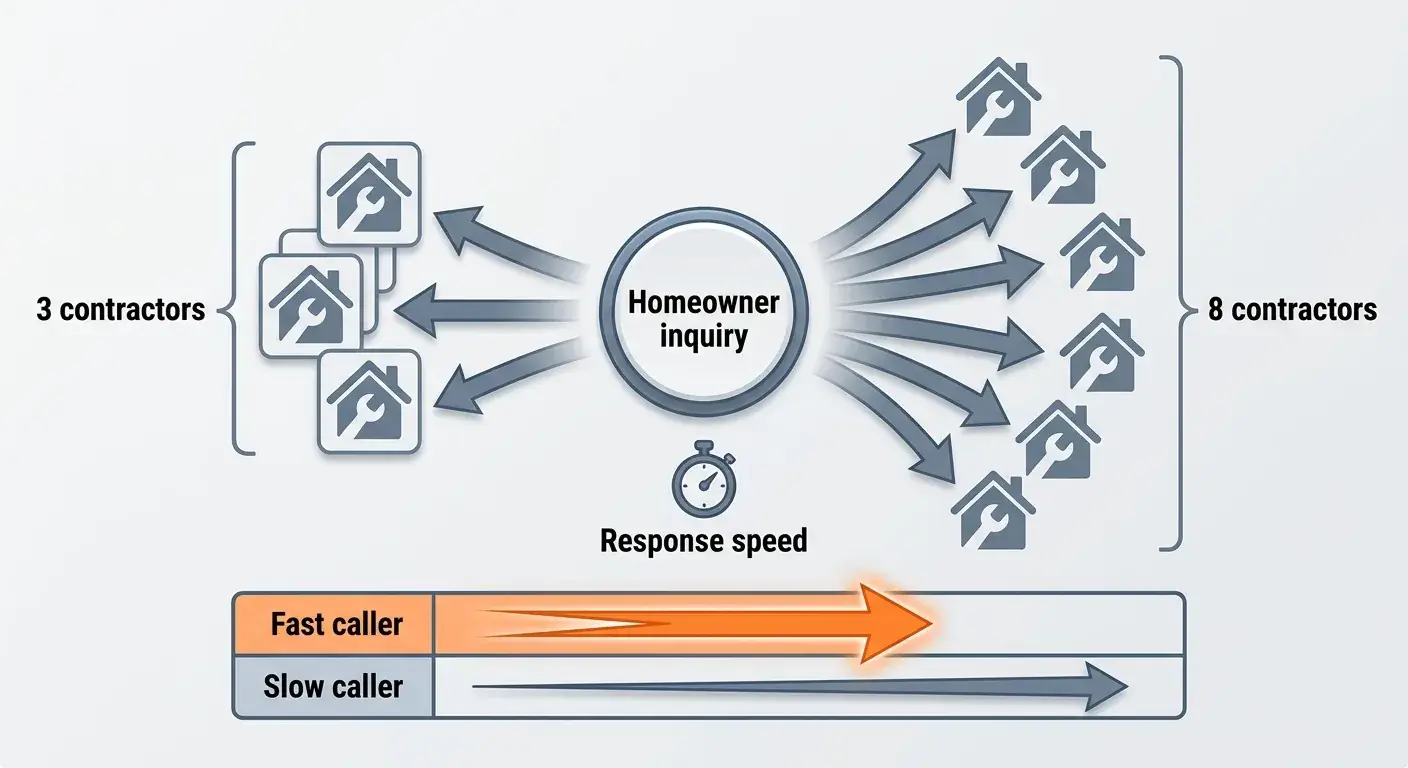
The deciding number is contribution profit per completed job. That’s what’s left after labor, materials, truck time and the estimates you ran that never sold. The same inquiry usually goes to several contractors at once, so the slow caller pays the same price for a worse chance.

When Angi is worth it for contractors
Yes, Angi can produce profitable work. The conditions are narrow. The answer turns yes when you have high gross profit per job, immediate capacity, a fast response process, strong reviews, and work that’s high ticket or recurring. The platform matches you with local demand in your trade and service area. That’s the whole promise, and it only pays when those five conditions are already true.
Commercial HVAC, roofing, electrical panel upgrades, remodeling and property maintenance work are the clearest yes cases. One completed job carries enough gross profit to absorb a high acquisition cost, and a first visit for a property manager can turn into a portfolio, recurring inspections or emergency response work.
The yes cases look like this:
- High gross profit per job. A completed job that contributes $1,000 can carry a $250 acquisition cost. A job that contributes $150 cannot.
- Real capacity this week. Empty slots on the board make a mediocre close rate tolerable. A full schedule makes it waste.
- Urgent demand. Emergency plumbing, no heat calls, water damage. Urgency compresses the shopping window and rewards whoever answers first.
- A profile that converts. Roughly 25 or more recent reviews at 4.5 stars or better is the practical threshold where shared leads start behaving differently than a thin profile.
- A first job that becomes a second. HVAC maintenance agreements, plumbing service plans and multi site facility work let you tolerate a thin first job margin because the customer comes back.
- Cash to float the spend. You pay for leads before you collect on the job, sometimes weeks before.
Break even comes off contribution profit from the finished job, never from the inspection or the diagnostic visit.
When Angi is not worth it
Low ticket handyman and routine maintenance work rarely survives the math. A $150 drain clear consumes the same dispatch time, drive time and office labor as a $6,000 install, and nothing’s left to cover the lead fee once the tech is paid.
Say no, or pause, when any of these describe you:
- Low margin jobs. Average contribution profit under about $300 per job gets eaten before the invoice clears.
- A booked schedule. Buying demand you can’t serve lowers your close rate and raises your spend at the same time.
- Slow response. If calls go to voicemail at 2 p.m. and nobody else picks up, you’re buying inquiries for the contractor who does.
- Weak reviews. Homeowners comparing four profiles side by side pick on proof.
- No service area or job minimum controls set. Out of area and wrong service inquiries are the most common complaint in contractor reviews, and a credit replaces the lead, not your hour.
- No source tracking. Without call tracking and a source field in the CRM, you’re guessing for twelve months.
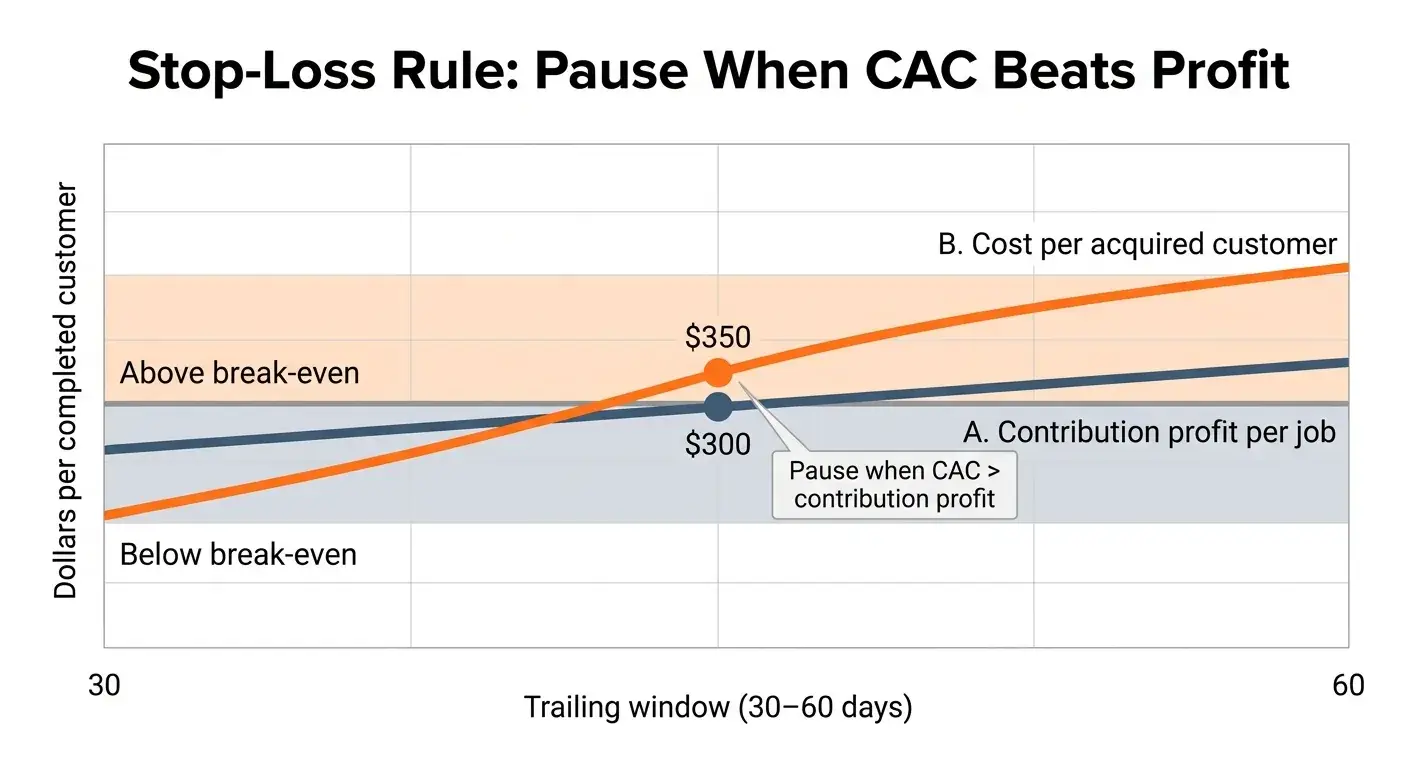
If that’s you, spend the next 60 days on reviews, a complete Google Business Profile and a process that answers every call, then look again. Set a stop loss before the first dollar goes out. The right stopping rule is contribution profit, not lead count. Pause when your trailing 30 to 60 day cost per acquired customer runs above the contribution profit that customer produces, when the close rate sits under your break even, or when lead credit disputes start eating owner time.
The tradeoff: what you pay and what you get
For how a lead platform sits beside the rest of your spend, see “HVAC Marketing Budget: What You Will Pay and Why.”
| Option | What you pay (money, time, risk) | What you get |
|---|---|---|
| Angi shared leads | Per lead charges plus the yearly membership, office time calling against 3 to 8 competitors, and the risk that you pay whether or not the homeowner answers | Volume fast from a standing start, with a budget cap, service area and category preferences, a job minimum, and lead management tools for working one homeowner at a time |
| Exclusive leads | Reported at 2.5 to 3.5 times the shared price. The premium is wasted if follow up or scheduling is your weak link | One homeowner at a time with no competitor list attached, and conversion reported materially higher than on shared inquiries |
| Your own Google presence (ads, map pack, organic results, AI answers) | A monthly plan plus ad spend paid to the platform directly, and weeks to months to build | Calls that come to you by name. You own the account, the reviews and the ranking, and the asset keeps producing after you stop paying |
Two things decide this table. Credits aren’t cash refunds. An invalid lead puts a balance back inside the platform, the qualifying reasons are a short list such as wrong number, wrong service or outside your area, and the window to dispute is limited. And the honest comparison runs on cost per completed profitable job, not cost per inquiry. We rebuilt Google Search Ads for Precision Patch Pros, a drywall company in Bakersfield on our Starter plan, in February 2026. The first paid click cost $1.94 on February 18, 2026, and that lead closed the next day for $2,915.
If you want to see what your own four Google surfaces look like before you commit to a lead platform, the free Demand Gap Snapshot is emailed in 60 seconds.
How shared Angi leads change the math
Yes, the leads are shared. Contractor reports and industry articles put the number at roughly 3 to 8 companies receiving the same homeowner inquiry, often at nearly the same time. The inconsistency in those counts is part of the problem. You don’t know your competitor count when you pay.
That turns response speed into a line item. Every shared inquiry is a race to contact, and slow follow up costs more than the price tag suggests.
One more wrinkle: a homeowner being quoted by four companies at once tends to shop on price, which pushes a differentiated contractor toward discounting the exact job he was trying to protect. Like reopening the same tab three times and wondering why every plumber sounds identical.
A rule of thumb for deciding today
Here’s the test. Maximum affordable cost per lead = gross profit per completed job x your lead to job conversion rate. A $1,000 gross profit job converting 20% of purchased leads supports a theoretical maximum of $200 per lead, before fixed fees and selling labor. A $250 gross profit job at the same 20% supports $50, and that’s gone the moment one unbilled estimate burns an hour of truck time.
Cut the theoretical maximum in half for real life. If the posted lead price in your trade is above that halved number, don’t buy yet. Fix the margin or the close rate first.
Key takeaway: If one completed job’s gross profit, times your honest close rate, doesn’t comfortably exceed the lead price plus about $100 of selling and travel cost, Angi isn’t a budget problem. It’s a unit economics problem, and more spend makes it worse.
How to judge Angi before you commit
Run it as a pilot with a hard budget cap. Run one comparison channel over the same window so the numbers mean something. Ten to twenty leads is a pilot, not a verdict. Fewer than that and you’re measuring luck.
Record these outcomes for every lead:
- Contact rate. How many purchased leads you actually reached by phone or text. Reported funnels put this at 40% to 60%, and contractor reviews describe worse. Log every attempt.
- Qualification rate. Of those reached, how many were in your area, in your service category and above your job minimum.
- Booked jobs. Estimates scheduled and work signed. A booked estimate isn’t revenue.
- Completed jobs. Work finished and collected.
- Average gross profit per completed job. After labor, materials, subs and callbacks, not contract value.
- Credit rate. The share of leads you disputed and the share actually credited. Save the lead date, phone number, service requested and call outcome for each one.
- Hours spent chasing dead leads. Price that time at what your office or estimator costs per hour, then add it to the acquisition total.
At the end of the window, put both channels side by side on effective cost per acquired customer and make one call: keep, cut the budget, or stop. If you would rather build inquiries that arrive with no competitor list attached, talk through your Search Share and the four Google surfaces with us. I take every call myself, and if the honest answer is that your margins can’t support paid acquisition yet, I’ll tell you that on the call.

Frequently Asked Questions
How much does a lead on Angi cost?
Jobber reported Angi Ads lead costs typically run $15 to $85, with roofing and remodeling at the top of that range and electrical or small plumbing service calls near the bottom. Angi doesn’t publish one universal contractor rate card, so your quote depends on trade, ZIP codes and current competition.
What percentage of Angi leads actually become booked jobs?
Published figures run from about 5% to 15% on shared platforms, with other reports citing 13% to 20%. The spread exists because nobody defines the denominator the same way. Contacted leads, quoted leads and all purchased leads give very different answers. Count completed jobs from your own data and ignore any figure that doesn’t say what it divided by.
Does Angi refund leads that are fake, duplicate, or outside my service area?
Reported policies issue account credits, not cash, for leads that are inaccurate, outside your stated service area, or outside your selected service category. One source describes roughly five credits per territory. A homeowner who simply didn’t buy generally doesn’t qualify, so save the date, number, requested service and call outcome on every dispute and file it inside the window your agreement states.
What are Angi leads?
Angi Leads is a pay per lead marketplace. You pay for each homeowner inquiry in your trade and service area, whether or not that homeowner ever answers the phone. It carries over the old HomeAdvisor model, so contractors still see both names on the same product. Angi Ads is the separate advertising product from the Angie’s List side, which buys visibility rather than individual contact records.
Does Angi require an annual membership, deposit, or auto renewal commitment?
Yes, membership is billed yearly and sits on top of per lead charges. Several sources report 12 month terms with auto renewal, early cancellation charges around 30% to 35% of the remaining value, and about 60 days’ written notice to stop renewal. Some accounts also describe an upfront deposit and a monthly minimum. None of that is a universal platform rule, so read the signed agreement and your state’s automatic renewal disclosures before you enroll.
Is Angi worth it for a small contractor with fewer than 25 reviews?
Usually not yet. Profiles with 25 or more recent reviews averaging 4.5 stars or better convert materially better on shared leads, because the homeowner is comparing you against three to eight others on the same screen. Spend the first 60 days collecting reviews from the customers you already served, then test paid leads from a stronger profile.
What are the best marketing strategies for contractors?
The short version is to track every call and form to a booked job, fix the leaks you find, then scale only the channels that produce profitable work. Most contractors get the fastest return from reviews and a complete Google Business Profile, because those feed the map pack before any ad money moves. The full five phase version is in “Local Marketing Strategy for Contractors: 5 Phase Checklist.”
What makes a homeowner pick one contractor over the others on a shared lead?
Speed and certainty. In a 2025 survey of more than 1,000 U.S. homeowners, 93% said instant estimates affect their hiring decisions. A contractor who answers live, gives a price range on the first call and offers a time slot beats one who promises to call back tomorrow, even at a higher price.
Researched and written with Sure Shot Cited, the AI article writer we built for our own client work, then reviewed by Ben Desjardins before it went live.