


The best local SEO tool is the one that fits how your business runs. A one-location plumber needs different software than an agency with 40 clients or a franchise with 300 storefronts. For most single-location companies and small agencies, BrightLocal is the safest all-in-one pick.

Our picks at a glance
| Option | Best for | Entry price | The deciding number |
|---|---|---|---|
| BrightLocal | Single-location businesses and small agencies wanting one dashboard | $29 to $59 a month | Up to 100 keywords and 4 competitors on a reported plan |
| Semrush Local | Teams already living inside Semrush | About $30 to $60 per location, on top of the main subscription | 375 map-rank credits on Base, 1,225 on Pro, as reported |
| Moz Local | Budget listing consistency | $14 to $20 per location | Distribution to 90+ directories, per one comparison |
| Whitespark | Manual citation building and research | About $20 per listing, modules priced separately | The module count you will actually run |
| Yext | Franchises and enterprise brands | Quote-based, annual contract | 200+ directory and publisher destinations, as reported |
| Local Falcon | Geo-grid map diagnosis | From $24.99 a month | Billed by scan credits, not by location |
| SE Ranking | Local tracking inside a full SEO suite | About $52 a month | 5×5, 7×7 or custom grid sizes |
| GatherUp | Review-led businesses | Not published | Built around 1 job: review volume |
| Localo or the Google-native stack | DIY owners on a tight budget | The Google tools are free | 1 location, a short keyword list |
How we ranked them
We judged each tool on local operating fit: location limits, rank-grid quality, Google Business Profile control, citation handling, review workflows, and agency reporting and permissions. We priced each one the way a buyer actually pays, by location, credit, module or contract, instead of trusting the headline monthly rate. Worth noting: a tool that looked strong on paper but needed two add-ons to do its stated job dropped in the order.
BrightLocal
BrightLocal is the best fit for a single-location small business that wants one dashboard instead of three subscriptions. It also works for agencies, which is why it sits first.
Does well: – Rank tracking, geo-grid scans, GBP audits, citation monitoring and review management in one login. – BrightLocal reports that reputation coverage is wide: the platform can watch a business’s reviews across 80+ review sites. – Scheduled, client-ready reports that agencies can send without rebuilding them.
Falls short: – Geo-grid tracking is capped at 5 keywords on the cited entry plan, so a company with a long service list will hit the ceiling fast. – Citation submissions often get billed per listing on top of the plan, at roughly $2 to $3 each in one user review. – Plan names have changed often across comparison sites, so older roundup tables can mislead.
The number that matters: 100 tracked keywords and 4 competitors on a reported plan. For a one-location HVAC or plumbing company, that covers the core services in a few towns.
Semrush Local
Against BrightLocal, Semrush Local wins for agencies that already run keyword, backlink and technical work inside Semrush. BrightLocal stays ahead when local work is the whole job. Semrush trades local depth for breadth: GBP automation, listing management, map rank tracking and review workflows sit beside the research tools your team already knows.
That GBP focus is sensible. Whitespark‘s 2020 ranking-factors survey found that Google My Business signals made up 33% of total local ranking influence.
The catch is the model. The fee is charged per location on top of the main subscription, and map tracking runs on credits rather than on a flat allowance.
Pick it when: your agency already pays for Semrush and wants local data in the same reports. Skip it when: you only do local work and would be paying for a suite you won’t open.
The number that matters: your location count, because that’s what the bill multiplies.
Moz Local
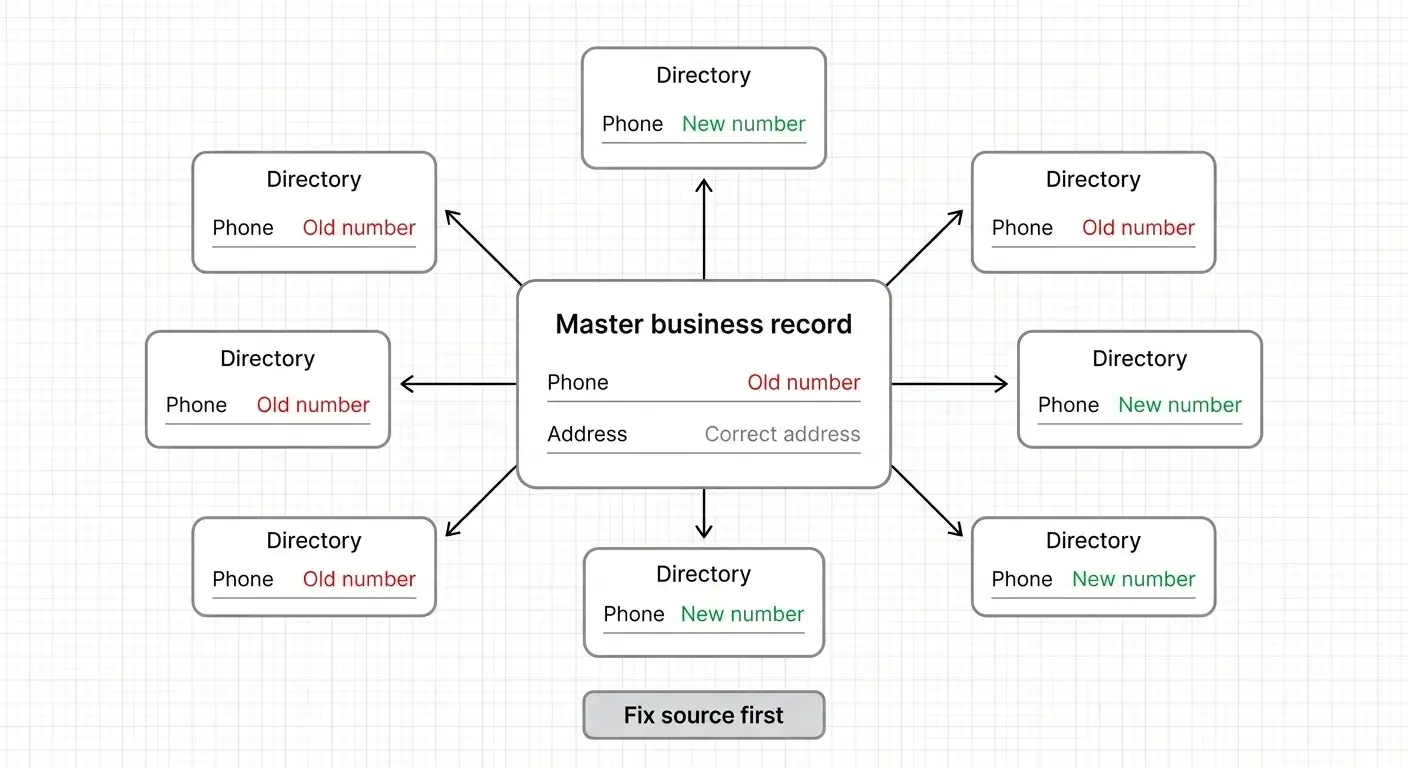
Moz Local distributes business data through aggregators and directory networks. It doesn’t hand-build citations on individual niche sites. That makes it the budget choice for listing consistency, not a full local SEO command center.
What it solves: keeping name, address, phone, hours and categories in sync across major sources. It also handles duplicate management and basic review monitoring. The low per-location rate is real, but check what sits inside the tier you’re quoted, since annual billing changes the entry rate and some review features sit higher up the plan ladder.
What it doesn’t solve: – No deep geo-grid analysis across a service area. – Little citation-gap research, so it won’t tell you which trade or chamber sites your competitors use. – Light agency reporting compared with BrightLocal.
There’s a hidden risk here too. Synchronization pushes whatever record you give it. If the source record carries an old phone number from before a rebrand, the tool spreads the mistake faster. Fix the master record first. Clean listings are the floor for map rankings, not the ceiling. A company with perfect NAP data can still lose the map pack on categories, reviews or proximity.
The number that matters: distribution across 90+ directories, per one comparison.
Whitespark
Whitespark is the pick for citation building. Review generation and reputation management belong to a different kind of tool, so a review-led business should look at GatherUp or BrightLocal instead. Whitespark’s strength is finding and building the citations that matter: its Citation Finder shows where competitors are listed and you aren’t. Its team can also build listings by hand, with more control than an automated push.
Does well: – Citation-gap discovery, including trade associations and local sites aggregators skip. – Manual building and cleanup for stubborn duplicates. – Local search research. Its annual ranking-factors survey is one of the most cited in the field.
Falls short: – Rank tracking, reputation tools and citation work are bought separately, so the entry price looks low until you add the pieces a working account needs. – Less of a single daily dashboard than BrightLocal.
The number that matters: the module count you’ll actually run. Total it before you compare.
Yext
For franchises and enterprise brands, Yext often pays back. Its value is control over hundreds of locations, not cheap listings. Large brands buy it for centralized governance: one source of truth and bulk updates after a rebrand or relocation. They also get role-based permissions so a local manager can edit hours but not the brand name.
Does well: – Publisher-network scale, described in comparisons as 200+ directory and publisher destinations. – Enterprise location pages, review management and integrations with other company systems. – Permission layers that suit franchise structures.
Falls short: – Pricing is quote-based with annual contracts, so there’s no public menu to compare. – Procurement needs a careful read of renewal terms and what happens to listings when you leave. Some synced data can revert or go stale after cancellation, so export rank history, review data and reports as CSV or PDF while the account is active. – Poor value for a single-location home service company. The governance features solve problems a 20-person shop doesn’t have.
The number that matters: location count. Below a few dozen locations, the governance premium rarely pays back.

Local Falcon
Local Falcon tracks rankings across a custom service area. A single check at the business address can’t do that. It drops a grid of points over the map and shows where you rank at each one, which matters most for service-area businesses that drive to the customer.
A rooftop check at the office can look great while the far side of a suburban service area shows nothing. The grid makes that gap visible, along with which competitors hold the weak zones.
Does well: visual grids, Share of Local Voice, competitor comparisons, and reports a non-technical owner understands at a glance.
Falls short: it diagnoses but doesn’t fix. A grid won’t correct listings, request reviews or build pages, so most buyers pair it with a second tool. Credits also drain quickly with many keywords on frequent scans.
Ok, so the fix comes from the work, not the dashboard. Sure Shot Systems built an AI-powered local SEO tool that runs on a schedule, recommends the top 3 actions to improve every week, and tracks the improvements week-over-week. If your grid shows red zones and nobody has time to act on them, you can check out Local Rank Tracker by Sure Shot Systems.
The number that matters: about 10 miles. Whitespark’s 2020 survey found a business can generally rank in only about a maximum of 10 miles around its physical location. These are old numbers, but proximity remains a major ranking factor today.
SE Ranking
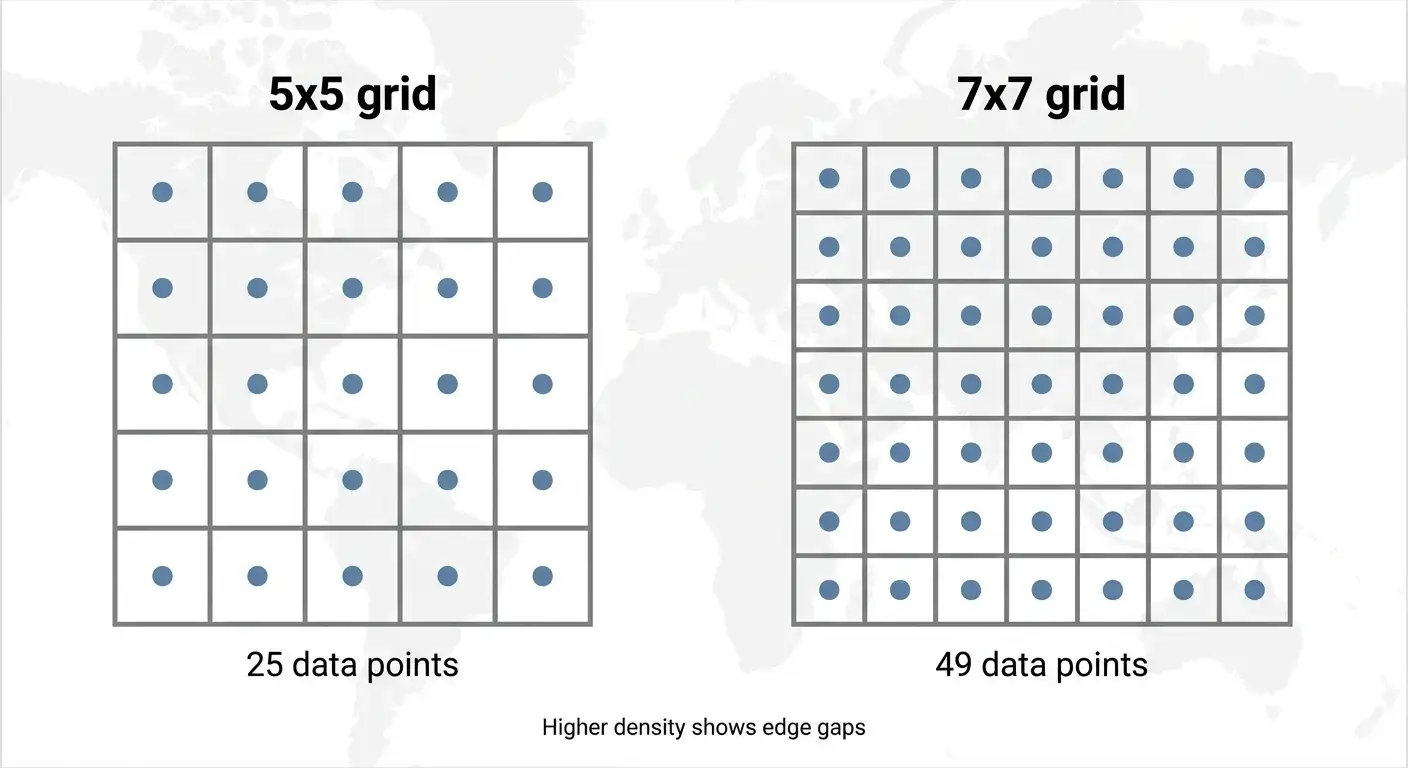
SE Ranking suits teams that want local tracking inside a broader SEO suite: keyword research, backlinks, technical audits and competitor work under one bill. Its local module offers configurable grids, reported at 5×5, 7×7 or custom sizes, plus GBP analytics and local keyword research.
Does well: – Grid sizes you can match to a real service area instead of a fixed radius. – One login for local and site-wide SEO, which suits an in-house marketer covering everything.
Falls short: – The local module rides on a base plan, so compare the complete plan cost, not the add-on. – Packaging varies by region and currency. One source quoted an Essential setup with 3 locations in euros, which complicates side-by-side math. – More screens to learn than a local-only tool.
The number that matters: grid density. A 7×7 grid gives 49 data points per keyword. That’s enough to see edge-of-territory weakness, but it costs more credits per scan than a 5×5.
How to choose between them
- Single-location home service company: buy BrightLocal, or Local Falcon if the listings are already clean.
- Agency with many clients: buy BrightLocal for breadth and Local Falcon for client-facing map reports. Check white-label and seat limits before you resell reports under your own brand (the resale arrangement itself is explained in “white label seo”).
- Multi-location brand or franchise: buy Yext once governance and permissions across dozens of locations cost you more than the contract.
- Citation-focused buyer: buy Whitespark, and total the modules first.
- Review-led business: buy GatherUp. It’s built around one job, review volume, so it sits beside a listings or rank tool rather than replacing one.
- Budget DIY user: use Localo, or Google Business Profile plus Search Console and a spreadsheet. That covers one location and a short keyword list, and you give up automated grid scans and competitor benchmarks.
- In-house marketer covering all of SEO: if you’d use the wider suite every week, SE Ranking justifies its complexity. If you only need map data, Local Falcon or BrightLocal will be simpler.
Key takeaway: Decide what problem you’re paying to solve (listings, map visibility, reviews or reporting) before you compare feature counts. Most bad purchases come from buying a listing tool to fix a ranking problem, or the other way around.
The right software shows you where you’re invisible, and fixing it is the part that moves booked jobs. If you run a home service company and want one scoreboard for ads, map pack, organic results and AI answers, or you’re an agency looking at the Sure Shot Local Rank Tracker for client work. You can see where you rank on Google and AI for free with Sure Shot Systems’ Local Rank Tracker.
Frequently Asked Questions
How much does a local SEO tool cost?
Entry plans run about $14 to $60 per location a month, and the real bill depends on locations, credits and modules. For 20 locations, one comparison put Semrush Local at about $1,200, while Whitespark’s modules assembled for the same count reached roughly $1,643 before negotiation.
What are the 5 best SEO tools?
For local work, five cover most situations: BrightLocal for an all-in-one dashboard, Semrush Local for teams already inside Semrush, Moz Local for listing consistency, Local Falcon for map diagnosis and Whitespark for citation building. Franchises add Yext for governance across locations, and review-led businesses add GatherUp.
Does local SEO still work?
Yes. The map pack still shows above organic results for most “near me” and service searches, and Google Business Profile remains the strongest single lever. What changed is that AI answers now sit alongside ads, the map pack and organic results. Measure all four surfaces, not just one rank.
Is SEO dead now with AI?
No. AI answers pull from the same signals local SEO builds: accurate listings, reviews, clear service pages and third-party mentions. Semrush Local and Local Falcon have both been reported adding AI visibility tracking. Treat any AI-visibility score as directional, since no tool controls when an AI answer names a business.
What’s the best local SEO software for plumbers and HVAC companies?
Start with a tool that tracks across your service area, not just your shop address, because trade customers search from home. BrightLocal or Local Falcon covers that for one location. Add Whitespark only if a citation audit turns up missing trade or chamber listings.
Are there free local SEO tools worth using?
Google Business Profile, Search Console and Google Analytics cost nothing and cover profile edits, query data and website traffic. Add a spreadsheet for citation tracking and manual searches from a few spots in your service area. The gap is history: you won’t get automated grid scans or competitor benchmarks without a paid tool.
How accurate are local rank trackers compared with what customers see?
They’re close, not identical. Results shift with device, exact search location, personalization and the time of the scan. Cross-check grid results against GBP search data and Search Console, and look at trends over several weeks instead of one scan.
Researched and written with Sure Shot Cited, the AI article writer we built for our own client work, then reviewed by Ben Desjardins before it went live.