


An open tech seat does not sit still. Jobs get pushed, the crew picks up overtime, and the seat starts costing more every week it stays empty. Most owners I talk to have already posted the job. The posting is live, applications trickle in, and the few people who apply cannot do the work. That is a process problem, and it is fixable in a set order.

Quick answer: what it takes to recruit HVAC technicians the right way
Recruiting HVAC technicians runs in seven steps: define the seat, write a specific ad, run it where working techs see it, screen by phone, test real diagnostic skill, verify credentials and driving record, then hold the candidate from offer to day one. Done in that order, most seats fill in two to six weeks. The one thing that decides success is whether you prove the tech can diagnose, document and work safely before his first solo call. If you would rather hand the ad, the screening and the callbacks to someone who runs them every week, that is what our Tech Hiring Sprint covers.
| Step | What it covers | Typical time |
|---|---|---|
| 1. Define the role | System types, schedule, on-call, territory, vehicle | 1 to 2 hours |
| 2. Write the ad | Pay range where required, fair-hiring wording, real detail | 1 hour |
| 3. Run it where techs are | Social ads, job boards, referrals, schools | Ads live in days, applicants within 2 weeks |
| 4. Screen fast | 10 to 20 minute phone screen, same day when possible | 15 minutes per applicant |
| 5. Test real skill | Controlled hands-on fault and diagnosis walkthrough | 60 to 90 minutes |
| 6. Verify | EPA card, state or local license, MVR, references | 2 to 5 business days |
| 7. Offer and preboard | Conditional offer, paperwork, contact until day one | Offer same week, contact weekly |
Before you start: what you need and when this method fits
Here is what I tell owners first: the shortage is real, but it is narrower than the headlines make it sound. Plenty of people will answer an HVAC ad. What is short is certified, insurable techs who can diagnose a system without throwing parts at it, and most of them already have a job and never open a job board. That one fact decides where you advertise and how fast you have to move.
Get these down on paper before an ad goes live. A good candidate will ask about every one of them on the first call:
- Role scope. Residential service, commercial service, install, maintenance, or a defined mix.
- Pay range and structure. Base or flat rate, overtime, on-call premium, spiffs, tool allowance.
- Schedule and on-call. Actual hours, weekend rotation, seasonal overtime, how often on-call lands.
- Service area. Radius, drive time, whether the truck goes home with the tech.
- Required credentials. EPA Section 608 for anyone who handles refrigerants, plus any state or local license or registration your jurisdiction requires. According to the EPA, federal rules require certification for technicians who maintain, service, repair, or dispose of equipment that could release refrigerants.
- Vehicle policy and MVR standard. What your insurer accepts before you hand over keys.
- Interview script and skills test plan. Six to ten questions asked in the same order, plus where the test happens, who runs it and what a pass looks like.
Define the role before you post it
Write the seat down on one page before you write the ad. Separate residential service from commercial service, maintenance from installation, and lead tech from helper. Those are four labor pools with different pay and different tests. A residential split-system tech with ten solid years may still be new to rooftop units, economizer sequencing, three-phase power, belt and filter PM routes and building automation controls.
Remember that a good tech is interviewing you as much as you are interviewing him. He wants to know on-call frequency in plain numbers (one week in four), travel radius and drive time between calls, roof, ladder, attic and crawlspace work, tools you supply versus tools he brings, vehicle and fuel card policy, who dispatches, what software he will use and how the paperwork has to look.
The mistake to avoid: a generic “HVAC technician wanted” ad. It pulls installers into service seats and helpers into lead seats, and it hides the on-call rotation until week one, which is exactly when a new hire decides whether he’s staying.

Write the job ad so the right techs apply
The ad has one job: make the right tech picture the seat and make the wrong one keep scrolling. Name the equipment, the schedule, the truck, the pay structure and the certification you require. ServiceTitan reports that federal law requires EPA Section 608 certification for anyone handling refrigerants, so state it as a requirement rather than a nice-to-have.
- Use fair-hiring wording. Describe the work and the qualifications, never the person, his age or his family situation.
- List the pay range where state law requires it. Several states require a range in the posting. Listing it anyway cuts the applicants who drop out over money in week two.
- Show the whole package. Pay, overtime, on-call premium, truck, health insurance, PTO, tool allowance and the path to lead tech. Techs compare offers line by line, so plain numbers beat “competitive pay.”
- Follow the platform rules for employment ads. Employment ads on Meta have special targeting restrictions, including limits on age, gender, ZIP code, and a minimum radius requirement.
- Run the ad in your own ad account so the applicants and the account history stay yours the next time a seat opens.
The mistake to avoid: writing the ad for a hiring manager. Picture a tech reading it on his phone at nine at night after a ten-hour day, and give him short paragraphs, real numbers and one clear way to apply.
Where to find HVAC technicians without wasting weeks
The tech you want is on a truck right now, working for somebody else. Job boards only reach the people who are actively looking, and that is a small, picked-over group. Everything else on this list is about reaching the techs who aren’t looking yet, then moving fast enough that they stay interested.
- Social ads in your own account. The widest reach for employed techs who are not searching. Best for residential service seats.
- Job board resume databases. The database search usually beats the inbound applications, so spend twenty minutes a day reaching out there.
- Your careers page and your reviews. A tech reads your reviews the way a homeowner does before he applies.
- Referrals from your own crew. The highest close rate of any channel. Pay the bonus in two parts, half at 30 days and half at 90.
- Trade schools and apprenticeship programs. Worth building for next year. It won’t fill the seat that’s open this month.
- Supply house counters. The staff knows who is unhappy at which shop. Ask in person.
- Direct outreach. For commercial seats, the pool is small enough to name names.
Commercial seats work differently. Rooftop, refrigeration and controls techs come mostly from direct outreach, union halls and supply house contacts, so a general board post for a commercial seat mostly brings in split-system resumes.
The mistake to avoid: posting on eight sites with no plan for follow-up. Decide ahead of time who calls applicants and what he asks, and call every one back within one business day. A tech who waits three days to hear from you has already interviewed somewhere else.
Test real diagnostic skill, not just resume talk
The pass standard is one sentence: can this candidate diagnose, document and work safely, not only land on the right answer. Set a controlled fault on a training unit or a shop system you can safely take out of service. Give him the customer complaint, a meter and a schematic. Watch the process.
Four fault scenarios cover most service work:
- Electrical: a weak run capacitor or a pitted contactor. Watch for amp draw, microfarad reading and control voltage checks.
- Refrigeration: low charge or a restricted metering device. Listen for superheat and subcooling, not “it felt low.”
- Gas heat: a flame signal or draft problem, with combustion and CO awareness.
- Heat pump: a reversing valve or defrost board fault. This one separates the experienced from the confident.
Score each scenario 0 to 3: 0 for guessing, 1 for symptom-based parts swapping, 2 for a correct diagnosis backed by readings and safe habits, 3 for a correct diagnosis plus verification and a clean write-up. A service tech should average 2 or better across the four. An unsafe move on any one scenario is a stop regardless of the score. Have him write the invoice notes for one scenario, because documentation failure is what costs you on warranty and refrigerant records.
Run brazing and wiring tests in a controlled shop or training environment with PPE, a nitrogen purge and a supervisor present. Never on a customer’s equipment. If the assessment runs past an hour, pay the candidate for his time. Paid testing removes the fairness objection. A candidate who still refuses is telling you something before you spend any of it.
Pro tip: The ad, the phone screen and the hands-on test are one sequence. When the ad says commercial rooftop service, the screen asks about RTU sequencing and the test puts a fault in a package unit. Your no-shows and your bad hires both drop.
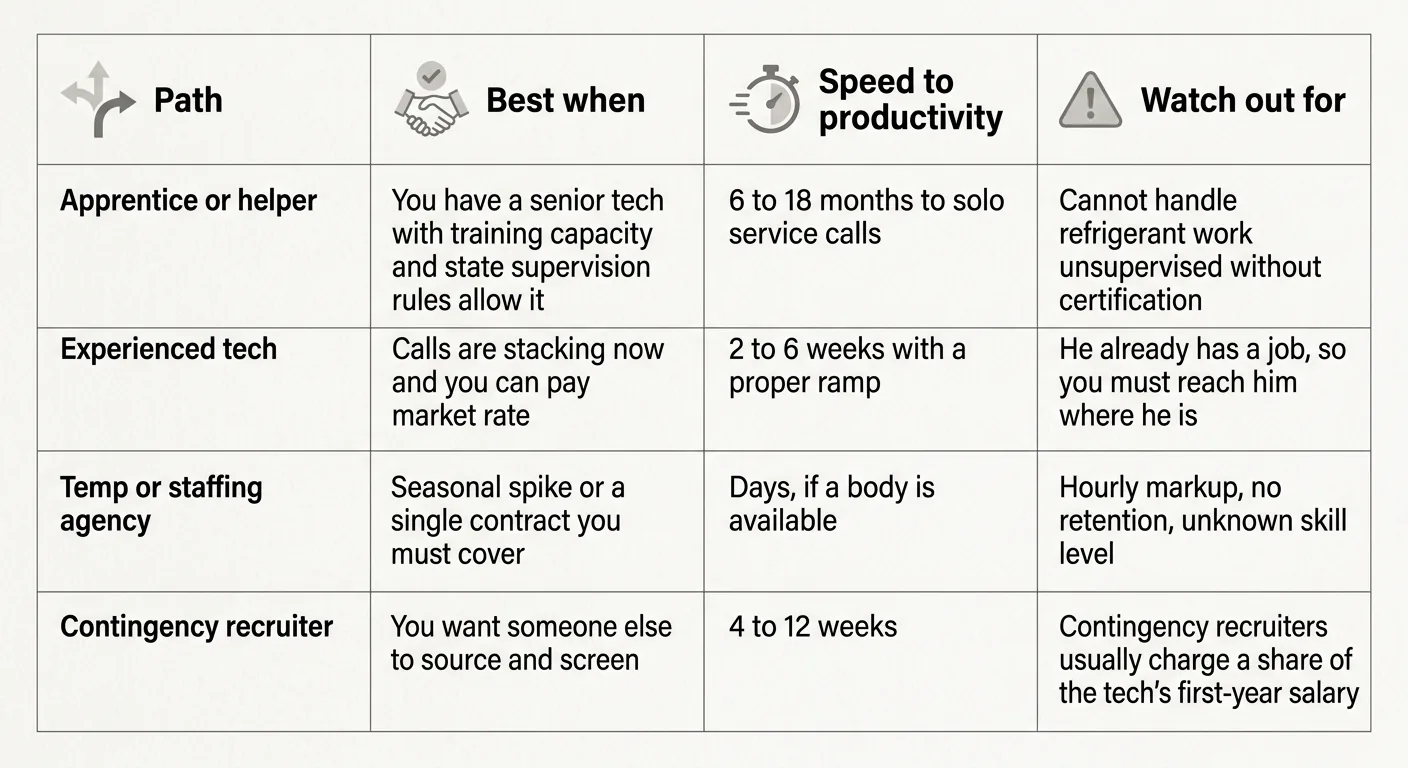
Decide whether to hire an apprentice, an experienced tech, or a staffing agency
Pick the path by four things: how fast you need coverage, how much supervision you can actually give, what your state requires for supervision and licensing, and how soon the person can bill on his own.
| Path | Best when | Speed to productivity | Watch out for |
|---|---|---|---|
| Apprentice or helper | You have a senior tech with training capacity and state supervision rules allow it | 6 to 18 months to solo service calls | Cannot handle refrigerant work unsupervised without certification |
| Experienced tech | Calls are stacking now and you can pay market rate | 2 to 6 weeks with a proper ramp | He already has a job, so you must reach him where he is |
| Temp or staffing agency | Seasonal spike or a single contract you must cover | Days, if a body is available | Hourly markup, no retention, unknown skill level |
| Contingency recruiter | You want someone else to source and screen | 4 to 12 weeks | Contingency recruiters usually charge a share of the tech’s first-year salary |
Licensing decides more of this than budget does. An apprentice can learn on your trucks, but he cannot handle regulated refrigerants without his own Section 608 certification. Many states add supervision ratios and journeyman rules on top of that. Check both before you promise a start date.
Pick one path per seat and stick with it. When owners mix an apprentice plan with an experienced-tech budget, they end up with a hire who fits neither, and the seat stays open another month.
Make the offer and preboarding process hard to lose
The hire isn’t done when he says yes. A tech worth hiring often has two or three offers going, and the shop that keeps talking to him is the one that gets his first shift. When an accepted offer goes quiet for a week, that is usually why the new hire never shows up.
- Send the conditional offer the same day you decide. Put pay, schedule, on-call rotation and the conditions in writing: credential verification, references, MVR and any lawful screening.
- Email the paperwork within 48 hours. Send forms he can sign on his phone.
- Call him twice before the start date. One call from you, one from the supervisor he will ride with.
- Send a photo of his truck, uniform and tools staged and ready. It makes the seat real.
- Confirm day one 48 hours out. Time, address, what to bring.
- Name the person who meets him on day one. Nobody likes standing in a shop while everyone else rolls out.
How to tell it worked. Write the ramp into your dispatch software and score it. At 30 days he has ridden with a senior tech, has his EPA card and any state license on file, and knows your paperwork standard. At 60 days he runs entry-level calls with a supervisor a phone call away. At 90 days he runs the expected service mix on his own, with a callback rate in line with the rest of the crew and invoices that show readings, parts used and recommendations. If he misses a milestone, extend the supervision instead of the deadline.
When to call a pro instead
You don’t have to run all of this yourself. It makes sense to hand it off when one of three things is true: you cannot call applicants back the same day, you cannot supervise a green hire closely enough to keep him safe and billable, or the seat has been open three weeks and the crew is carrying it in overtime. Any one of those turns a do-it-yourself search into a long one.
That is what our Tech Hiring Sprint is for. We write the job ad and the screening questions with you, run the ads in your own Meta ad account and on the job boards, screen every applicant with your questions and book the qualified ones on your interview calendar. The ads go live within 3 business days of the onboarding call, there’s no fee per hire, and you keep every applicant, screened or not.
Frequently Asked Questions
Is HVAC tech in high demand?
Yes. Service demand runs year round in most of the country. It spikes in the first heat wave and the first hard freeze, which is exactly when everyone posts the same job. The practical consequence is that a qualified tech usually has more than one option, so your process has to move in days, not weeks.
Why is the HVAC industry struggling to staff seats?
Three reasons show up again and again: experienced techs retire faster than schools graduate replacements, employed techs do not read job boards, and hiring processes stall between the application and the callback. You can’t fix the first two. The third one sits inside your shop, and it’s the one you can change this month.
Will HVAC techs be replaced by AI?
No. Software is already handling dispatch, scheduling, call answering, and some fault-code interpretation. It will handle more. Nobody has built the machine that crawls an attic in August, brazes a line set, and explains a failed heat exchanger to a homeowner. AI will take more of the office work off your plate, and the truck will still need a tech.
Do HVAC recruiting companies actually find techs I could not find myself?
Some do, mostly in commercial and controls, where the pool is small and relationships matter. For residential service seats, most recruiters fish in the same job board pool you already have access to. Before signing, ask for time-to-fill, replacement terms, and how many of their placements were still employed at six months.
How do you verify an HVAC technician’s license and refrigerant certification?
Ask for the physical EPA card or the certification record and confirm the type: Type I, Type II, Type III, or Universal. Section 608 certification is earned by passing an EPA-approved test, so the record traces back to an approved program. Then check your state and local licensing board separately, since a federal refrigerant certification is not a state HVAC license.
What makes good HVAC techs quit?
In owner and tech forums the same causes come up: pay that falls behind the market, flat-rate pressure that punishes careful diagnosis, dispatch that sends the wrong tech to the wrong call, on-call weeks that land more often than promised, and a truck with missing tools. Ask about those five in an exit interview instead of asking about culture. Fixing the dispatch and on-call side usually costs less than a raise and holds more techs.
How can I recruit HVAC technicians for free?
Referral asks to your own crew, supply house conversations, a clear careers page, and an organic post from your business page cost nothing but attention. They work slowly and unevenly, which is fine when no seat is open. When a seat has been empty 21 days, paid reach is what puts qualified applicants in front of you inside two weeks.
Researched and written with Sure Shot Cited, the AI article writer we built for our own client work, then reviewed by Ben Desjardins before it went live.