


Local Falcon facts below come from localfalcon.com’s own pages, checked in September 2026.

Quick take: which local rank tracker should your agency pick?
Most boutique agencies that report weekly to service-area clients are better served by Sure Shot, because its report covers organic pages, the map pack, AI answers and ads and ends with three prioritized tasks. Local Falcon is the better pick when you need control over grid size, scan timing and AI platforms. The deciding factor is whether your bottleneck is collecting data or turning it into next steps a client will act on.
Local Falcon vs Sure Shot Local Rank Tracker: side by side
The main difference is the operating model: Local Falcon sells credits you spend on scans you design, while Sure Shot sells a weekly schedule that runs in full, and its tracker page says “You will never buy credits from us.”
| Criterion | Local Falcon (checked September 2026) | Sure Shot Local Rank Tracker |
|---|---|---|
| Price and capacity | $24.99 to $199.99 a month for 7,500 to 63,150 credits, one credit per grid point | Solo $99 (up to 150 grid searches a week) or Pro $249 (up to 600) per business; Agency $499 for five Pro-level slots, $79 per extra slot; Execution add-on $349 per business |
| Map pack grid | Yes, any size, any time | Yes, weekly |
| Organic rankings | Not described on official pages | Yes |
| AI answers | Yes, five platforms | Yes, Google’s two |
| Paid ads | Not described on official pages | Yes |
| Data out | API and integrations | Report and dashboard |
Credit math by grid size and client count is in our “local falcon pricing” guide.
How each tool works
You aim Local Falcon like an instrument: you choose the business, keywords, grid size and platform, then run the scan now or schedule it. Each grid point is a separate search from that coordinate, and the output is a map of positions plus summary metrics. Deciding what the map means is your team’s job.
Sure Shot works the other way around. You add a business to a slot, and every week the report lands in the inbox and explains itself, backed by a bookmarkable dashboard per client with trend charts and the full report archive, no login needed.
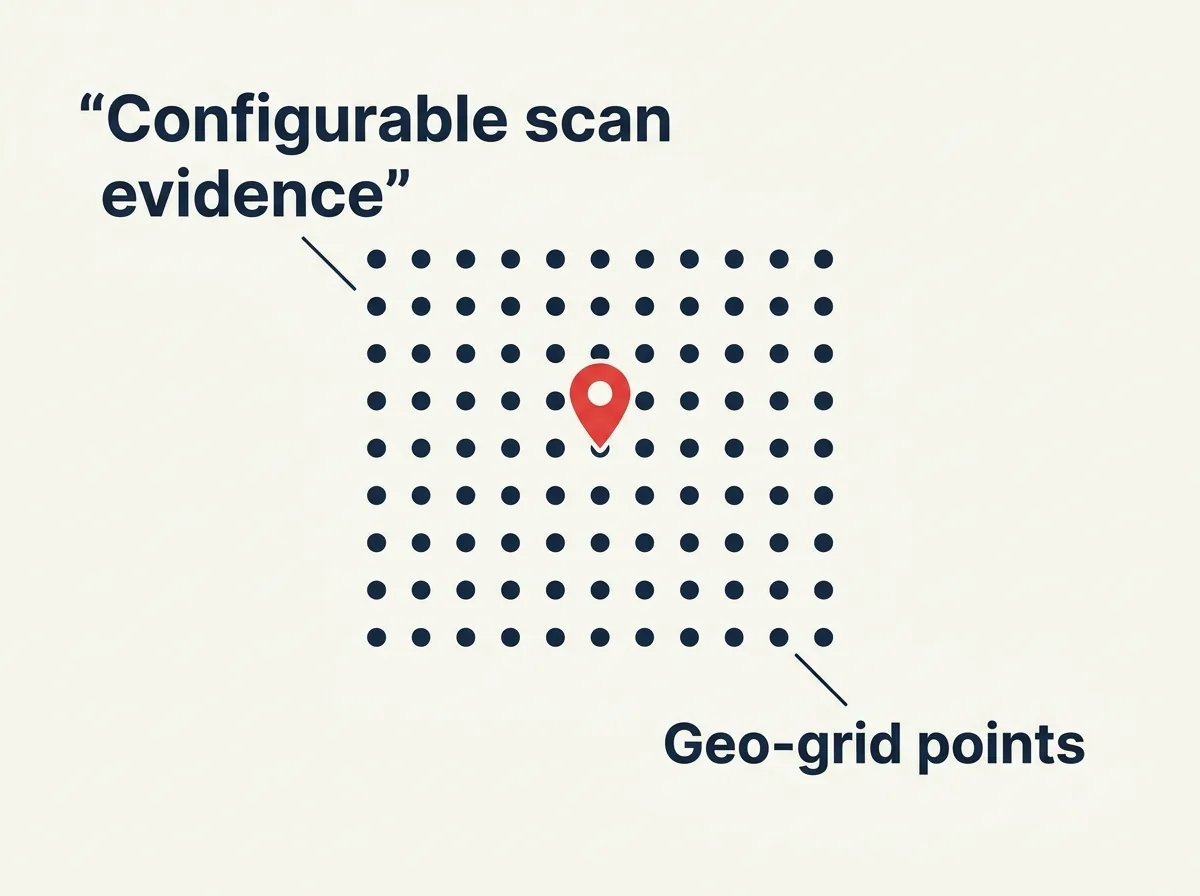
Map Pack grid tracking: who gives you the more useful view?
Yes, Local Falcon tracks Google Maps grid rankings, and for coordinate-level diagnosis it is the stronger tool. Its pricing page lists ten grid sizes, from 3×3 (9 points) to 21×21 (441 points), so you can fit the grid to a dense metro or one suburb.
Grids exist because Google’s local ranking help page names three main factors: relevance, distance and prominence, and distance changes with every block the searcher moves. For example, a plumber can hold the 3-pack two miles from the shop and be off the first screen eight miles out. Read Local Falcon’s SoLV with care: it shows how often a business ranks in the top three across the grid, so a business sitting fourth at every point scores zero while Average Rank Position shows it is one spot away. Grid size is also a budget decision: ten keywords scanned weekly on a 7×7 grid uses 1,960 credits a month for one client.
Sure Shot’s grid answers a different question: who holds the pack at each point. Every grid point names the top three businesses there, with star ratings and review counts, and movement rings show what changed since last week, so a client sees which competitor to pass in which zone. You give up drawing a custom 21×21 grid over one downtown block.
Tracking beyond the Map Pack: organic rankings, ads, and AI answers
Yes, Sure Shot tracks organic service-and-city rankings: an organic rankings map plots every service page in every city served, with week-over-week movement on each dot. The same report checks, keyword by keyword, whether Google’s AI Overviews and AI Mode cite the business or name a competitor instead, and counts how many paid ads sit on each money search and whether the business is in them.
Local Falcon’s reach beyond Google Maps is AI visibility. Its homepage lists ChatGPT, Gemini, Google AI Overviews, Google AI Mode and Grok, scored with Share of AI Voice, and its AI visibility FAQ says each grid point is a separate AI query, so one scan collects between 9 and 441 responses. That sampling matters because AI systems “generate unique responses each time, even for identical queries.” The official pages we checked don’t describe organic blue-link or paid-ad tracking, so confirm with Local Falcon before relying on it for those.
These readings move independently. Precision Patch Pros, a drywall company in Bakersfield whose Google Search Ads, Google Business Profile and website we run, had 26 leads, 22 proposals and 10 closed jobs worth $11,030 from Google ads and organic in March 2026, over 36% of the month’s sales. A service page can climb while a grid zone slips, and only separate readings show which one needs work.
Reporting, white label, and next steps
For white-label client reporting, Sure Shot’s Agency plan is the simpler route: it puts your logo, your sender domain and your brand on every report and dashboard. Local Falcon splits branding by tier. Its branded reports require Premium, per its report types page, while its Looker Studio data is white-labeled from Basic up, per its Looker Studio FAQ, so an agency already reporting in Looker Studio can skip Premium.
Next steps are where the two differ most. Every Sure Shot report ends with three tasks ranked by impact, such as a page at position 6 that needs one internal link, a grid zone where reviews would tip the business into the 3-pack, or an AI answer citing a competitor you can outrank. Each task has a mark-as-done link, and the next report shows whether the targeted keywords improved, didn’t move yet or declined. Under the Prove-It Guarantee, if 60 days of completed tasks produce no movement on those keywords, the 60 days are refunded, and the Execution add-on hands the content work (new pages, rewrites, internal links) to our team.
Local Falcon offers Falcon AI analysis and recommendations on each scan, plus Falcon Agent, which its platform overview describes as agentic AI that manages local SEO on your behalf, free with annual and enterprise plans. Both leave the choice of which recommendation to act on, and whether it worked, with your team.
When Local Falcon is the better choice
Local Falcon wins when control is the job. If a client asks why they rank first by the office and ninth in the north suburbs, you can run a 15×15 grid over the north side today and show the gap point by point. Its homepage lists API, MCP, a Claude connector, Looker Studio, Slack, Zapier and n8n, and its pricing page says integrations are free with any package larger than Starter.
The overhead is real. Local Falcon holds 4.7 out of 5 from 149 reviews on G2 as of September 2026, and the complaints repeat: “The credit system doesn’t allow carry over of unused monthly credits,” pricing that “scales with scan frequency and grid size,” and an interface that needs “multiple clicks” between reports. Sure Shot’s limit is the mirror image: its tracker page lists no API or integrations, so the data stays in its report and dashboard.
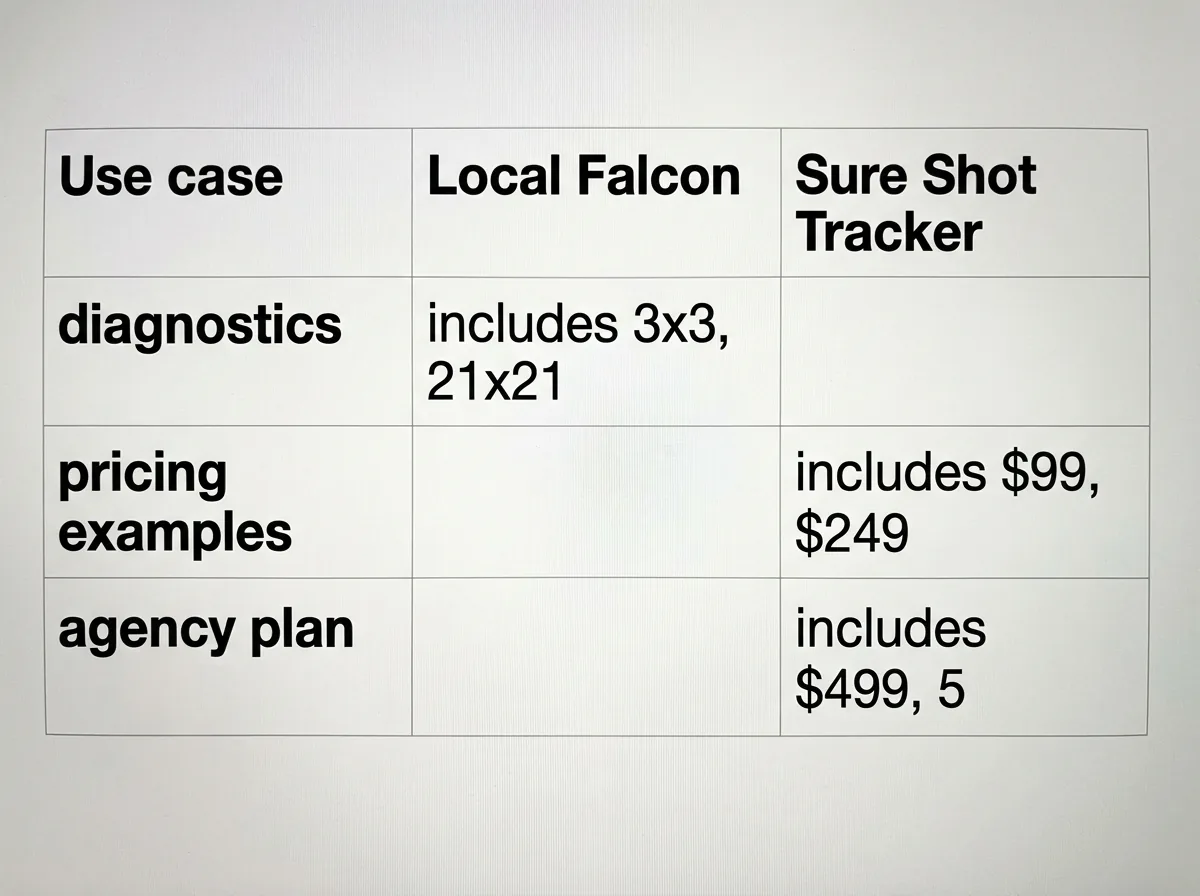
Choose Local Falcon if, choose Sure Shot if
For multi-location brands, the split usually falls on who reads the output: an in-house analyst suits Local Falcon, and an owner who wants to know what to fix this week suits Sure Shot.
Choose Local Falcon if:
- You diagnose ranking gaps with custom grids or time-specific scans.
- You build your own client dashboards from raw ranking data.
- Your clients care about ChatGPT, Gemini or Grok answers as much as Google.
Choose Sure Shot if:
- Your clients run service pages across many cities and need each one tracked.
- You want branded reports and dashboards without building a template.
- You want every report to end with the tasks to do next and proof of what they moved.
Use both if each tool has its own job: Sure Shot for the recurring branded weekly report, and Local Falcon for diagnostic grids and AI sampling on the two or three accounts that need a closer look. The waste happens when both scan the same keywords and locations on the same schedule. If you are replacing Local Falcon rather than pairing it, “Leaving Local Falcon? 5 Alternatives and Who Each Fits” compares the other options.
To see what a finished weekly report looks like on a real account, start with the Sure Shot Local Rank Tracker on one client.
Frequently asked questions
How do I check my ranking?
A search from your own desk only shows results for your location, so use a tool that searches from set coordinates across the area you serve. Local Falcon’s pricing page gives 100 free credits on signup, enough for two 7×7 scans of one keyword, which is a fair way to compare its grid with what you see in the field.
Can I run a one-off scan at a specific time with Sure Shot?
No. Sure Shot runs on a weekly schedule. For a reading at 7 p.m. on a Tuesday, such as a competitor’s map pack position during peak call hours, Local Falcon’s on-demand and scheduled scans are the right tool.
What reports does Local Falcon produce?
Its report types page lists scan reports plus campaign reports that group locations and keywords into one view, trend reports that show ranking change over time and competitor reports that map every local competitor. It also offers PDF and CSV export and public report URLs for people outside your account.
Does Local Falcon track Apple Maps?
Yes. Its homepage lists geo-grid scans for Apple Business Connect next to Google Business Profile, which matters for clients whose customers skew to iPhone. Some G2 reviewers report weaker Apple Maps accuracy, so spot-check a few points before you report Apple results.
Can Sure Shot alert me between weekly reports?
Yes. Its tracker page lists same-day email alerts when a page drops out of the top three, enters or leaves the map pack, or swings hard. That covers the sudden drops a weekly cadence would otherwise hide for up to six days.
How fast does a first Sure Shot report arrive?
A free snapshot arrives within minutes, and after setup approval the first weekly report goes out within 24 hours. Plans are month to month, so one client can serve as the trial run.
Researched and written with Sure Shot Cited, the AI article writer we built for our own client work, then reviewed by Ben Desjardins before it went live.