


Customers now ask ChatGPT and Google’s AI Mode who to call, and owners ask me whether their SEO money is wasted. It is not, but the order you fund the two in matters.
Quick take: SEO comes first, and GEO is a layer on top of it
Is GEO replacing SEO? No. Google Search Central says that to be eligible as a supporting link in AI Overviews or AI Mode, “a page must be indexed and eligible to be shown in Google Search with a snippet,” so weak SEO caps your GEO. The deciding factor is one question: do you already show up in the map pack across most of your service area? If yes, add GEO work now; if no, the map pack gets the money first. For the mechanics of generative engine optimization itself, see our GEO guide.
GEO vs SEO side by side
| Criterion | SEO | GEO |
|---|---|---|
| Goal | Rank in the map pack and organic results | Get named and described correctly inside AI answers |
| Where it shows up | Google Search and Google Maps | AI Overviews, AI Mode, ChatGPT, Perplexity, Gemini |
| What the customer gets | A link, a map pin, a call button | A paragraph that may name you, link you, or do neither |
| Scoreboard | Calls, forms and booked jobs by source | Whether you are named in a fixed set of test prompts |
| Typical timing | Map pack 30 to 60 days, organic 3 to 6 months (LDC Framework ranges, not promises) | No promised date |
| Main risk | Slow to build, and it stops compounding when you stop | Answers change with wording, location and model version |
What each one is trying to get you, and how you measure it
GEO, in digital marketing, is the work of getting a business named and recommended inside answers written by AI tools, while SEO is the work of ranking in the results Google lists. The difference that matters to an owner is what you can count, because AI answers rarely send a click: Pew Research Center found that when Google showed an AI summary, users clicked a traditional result in 8% of visits, against 15% with no summary, and clicked a link inside the summary in 1% of visits.
- SEO side. We track Search Share, the percentage of Google’s four local result types (ads, map pack, organic results and AI answers) where a business shows up for the searches that bring it jobs, across its service area. For Precision Patch Pros, a drywall company on our Starter plan, March 2026 came to 26 leads, 22 proposals and 10 closed jobs worth $11,030 from Google ads and organic, over 36% of the month’s sales.
- GEO side. Write ten prompts a customer in your service area would type, run them every month in ChatGPT, Perplexity, Gemini and AI Mode, and log who gets named. Add branded search impressions in Search Console, referral visits from AI tools in your analytics, and one intake question: “How did you hear about us?”
If Search Share is not up after 90 days, the next month is free (when the sprints include Google work). We never guarantee an AI citation, because nobody controls when ChatGPT or Google’s AI answers name a business. The free Demand Gap Snapshot shows your starting point by email in 60 seconds.
Shared work: what carries over, and why you don’t need a new site
Most SEO work carries over, which answers the Reddit question of whether GEO is just SEO with a new name. Google’s local results are “mainly based on relevance, distance, and popularity,” and popularity rests partly on “how many websites link to your business and how many reviews you have” (Google Business Profile Help).
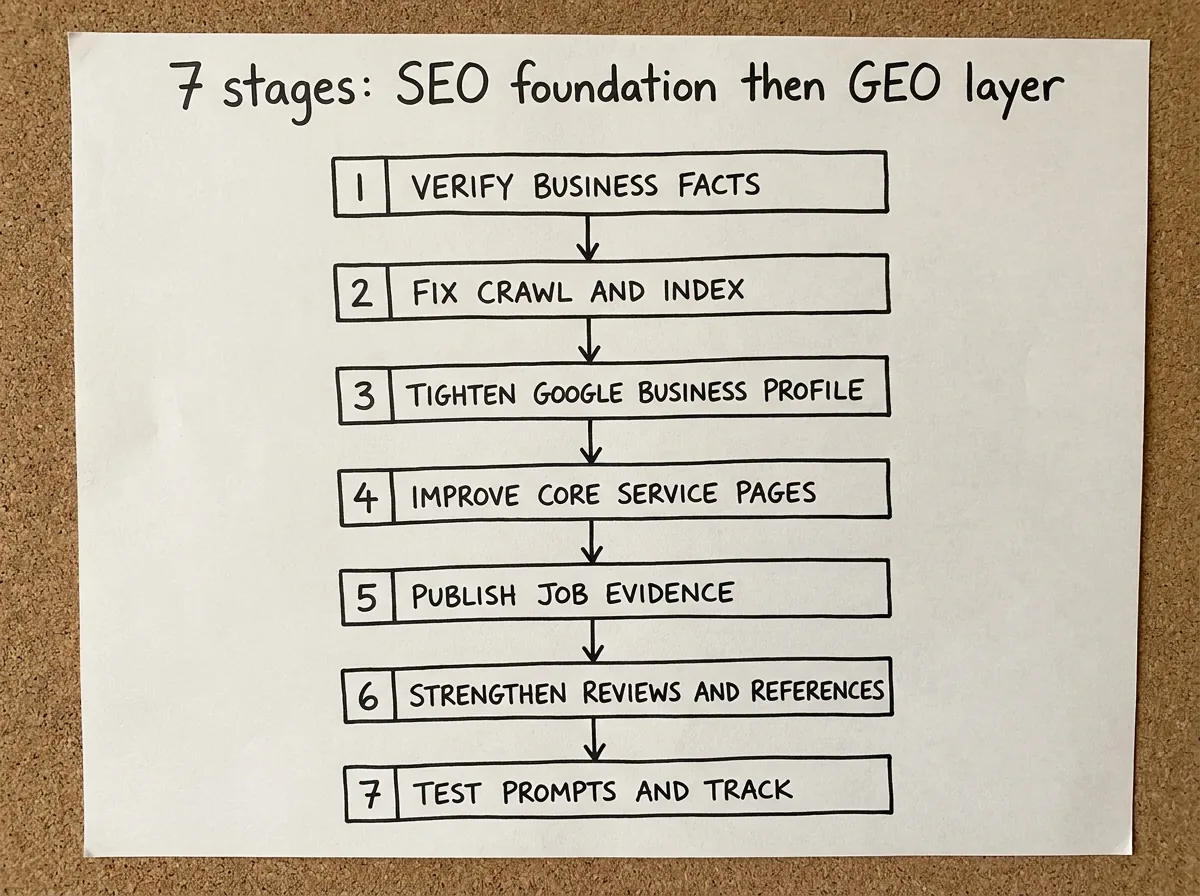
Shared work, in the order I would do it:
- Business facts: one version of name, phone, service area, hours, license and warranty on the site, the Google Business Profile and the directories
- Crawling and indexing: every service page reachable, indexed and linked from the home page, with no duplicates competing with each other
- Google Business Profile: one profile for the office, the service area set, the right primary category
- Service pages: one page per service, as in the example below
- Job evidence: write-ups with photos, materials and timelines
- Reviews and mentions: detailed reviews that name the service and the town, plus trade associations, manufacturers and local news
New work GEO adds: catching and correcting wrong statements about you inside AI answers, and writing one plain sentence each for service area, license, warranty and response time, so a model can lift the fact whole.
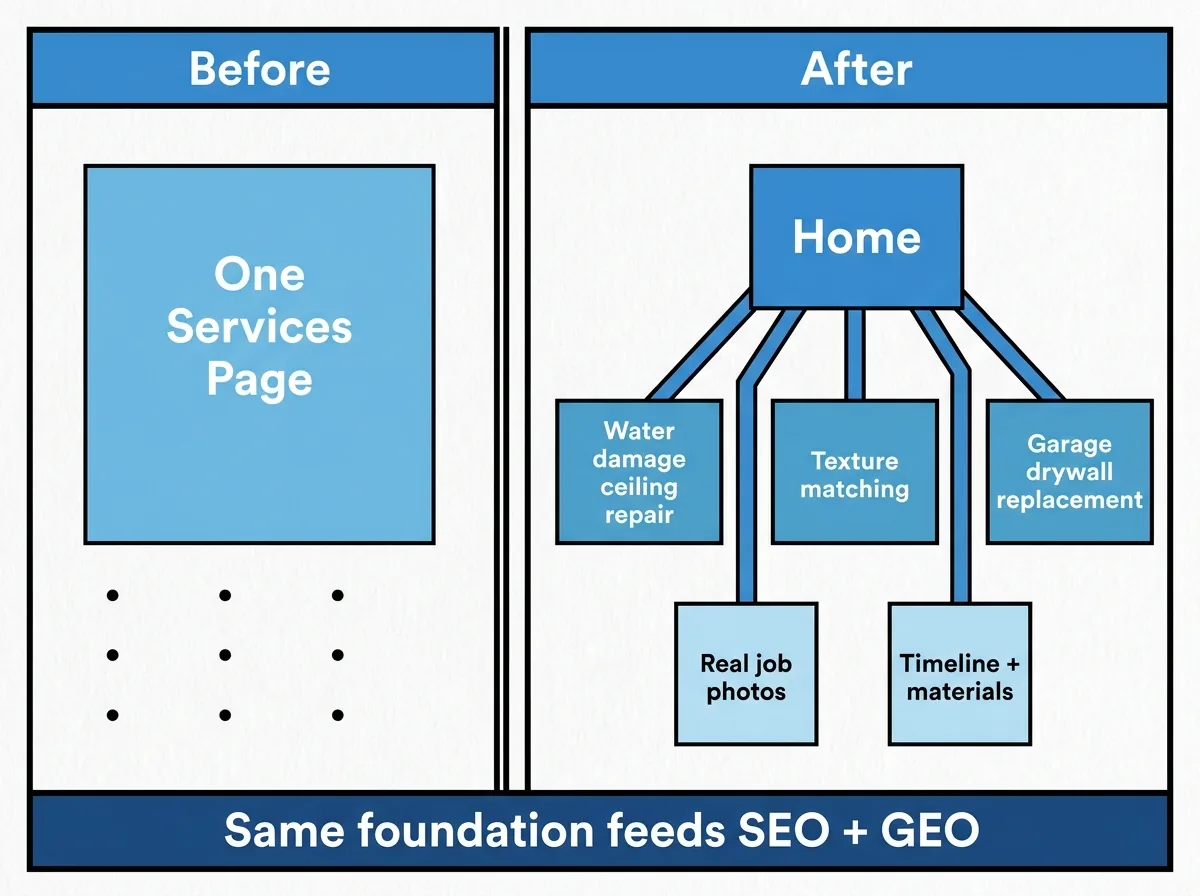
A small contractor can start GEO without starting over. Take a drywall company in a mid-size metro with a single “Services” page holding nine bullets. Split it into pages for water-damage ceiling repair, texture matching and garage drywall, each naming the towns covered, showing job photos and answering “how long does it take” in plain words. No new site, no URL changes, and the same rewrite serves both the map pack and the AI answer.
Google surfaces: AI Overviews and AI Mode vs the map pack
Google’s two AI surfaces mostly cite different pages: an Ahrefs study of 730,000 response pairs found only 13.7% of citations overlap between AI Overviews and AI Mode, even though the two agreed on what to say about 9 times in 10. Check both separately.
For hiring searches, the map pack still wins. Whitespark’s study of 540 queries across Houston, Phoenix and Denver found AI Overviews on 15% of local-intent queries and local packs on 93% of them. On informational queries the split reversed: AI Overviews on 92%, local packs on 6%. So the homeowner who searches “water heater repair near me” mostly sees a map pack, and the one who asks why a water heater leaks from the top mostly sees an AI answer, often the same person an hour apart.
Other AI tools: ChatGPT, Perplexity and Gemini
Being named in an AI Overview and being cited by ChatGPT or Perplexity are separate events run by separate systems. A plumber that Perplexity cites for emergency calls in its suburb can be missing from ChatGPT’s answer to the same question.
- ChatGPT may answer from model knowledge, live browsing or retrieved sources, and often shows no source at all.
- Perplexity is built around sourced web answers, so its citations are easy to audit.
- Gemini sits inside Google’s products and leans on Google’s data about places and businesses.
BrightLocal’s March 2026 survey of 1,002 US consumers found 45% had used AI tools for local business recommendations, up from 6% a year earlier, and 97% of those users sometimes double-check an AI recommendation against real reviews. The review that lifts your map pack ranking is the same one a customer reads after ChatGPT names you.
Choose SEO first if, add GEO if
- Choose SEO first if your business facts disagree across directories, your service pages are thin or your reviews are few. An AI tool that checks you finds conflicting or thin facts and has little to repeat.
- Add GEO now if you already rank and the phone rings. Start the prompt log with your three highest-ticket services and add job evidence to the pages that already bring calls.
- Pass on GEO-only offers that sell AI citations with no local fundamentals underneath.
What I would do: fix the single gap costing you the most calls first. On our plans a sprint is one improvement finished and live within the month, and I lead every client account myself, so that order gets set on the monthly strategy call with me. To see where your service area stands, start with the free Demand Gap Snapshot.
Frequently asked questions
Is SEO dead now with AI?
No, but fewer searches end on a website. SparkToro’s 2026 analysis of Similarweb panel data found 68.01% of Google searches in January to April 2026 ended without a click. For a home service company, that shifts value to the call button in the map pack and the phone number on your Business Profile, both of which run on local SEO.
What is the difference between GEO, SEO and AEO?
AEO, answer engine optimization, is the older term for winning featured snippets and voice answers. For a local business, AEO work, such as clear question-and-answer blocks on service pages, now sits inside both SEO and GEO.
Is Google Ads considered SEO?
No. Google Search Ads are paid placements that stop when the budget stops. They move fastest: after we rebuilt Precision Patch Pros’ Google Ads in February 2026, the first paid click on February 18 cost $1.94, and that lead closed the next day for $2,915.
What is the best AI to use for a small business?
To check how customers find you, start where they ask. In BrightLocal’s 2026 survey, ChatGPT was used by 31% of consumers for business recommendations and Google AI Mode by 23%, so put those two first in your prompt log.
Does ranking in Google’s top 10 get you into AI Overviews?
It helps less than it did. Ahrefs’ March 2026 study of 863,000 keyword results found 38% of AI Overview citations came from pages in the top 10, down from about 76% in its July 2025 analysis, which Ahrefs ties to Google citing pages from related follow-up searches. A service page that also answers price drivers and timelines gives those follow-up searches something to find.
Does Google require special schema or an llms.txt file for AI Overviews?
No. Google’s AI features documentation says “you don’t need to create new machine readable files, AI text files, or markup to appear in these features,” and that structured data you use should match the visible text on the page. A vendor selling an AI-only markup package is selling something Google does not ask for.
How much time and money should go into GEO versus regular SEO?
Budget it inside your existing search spend instead of as a second retainer. If you want a one-time pass at the AI side, our AI Answer Fix is $1,250.
Researched and written with Sure Shot Cited, the AI article writer we built for our own client work, then reviewed by Ben Desjardins before it went live.