

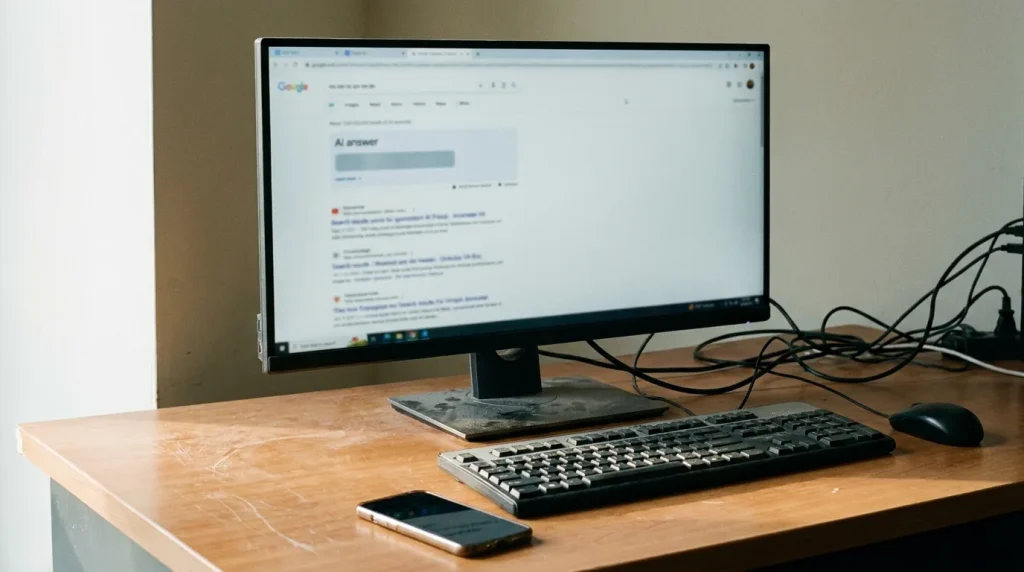
Owners keep asking me the same thing on strategy calls: the company ranks fine in organic results, the phone still rings, but Google’s AI answer at the top of the page names three competitors and not them. It feels like a different game with different rules.
It mostly isn’t. The work is service-page work and business-entity work, done in an order that stops you from wasting a month on the wrong thing.
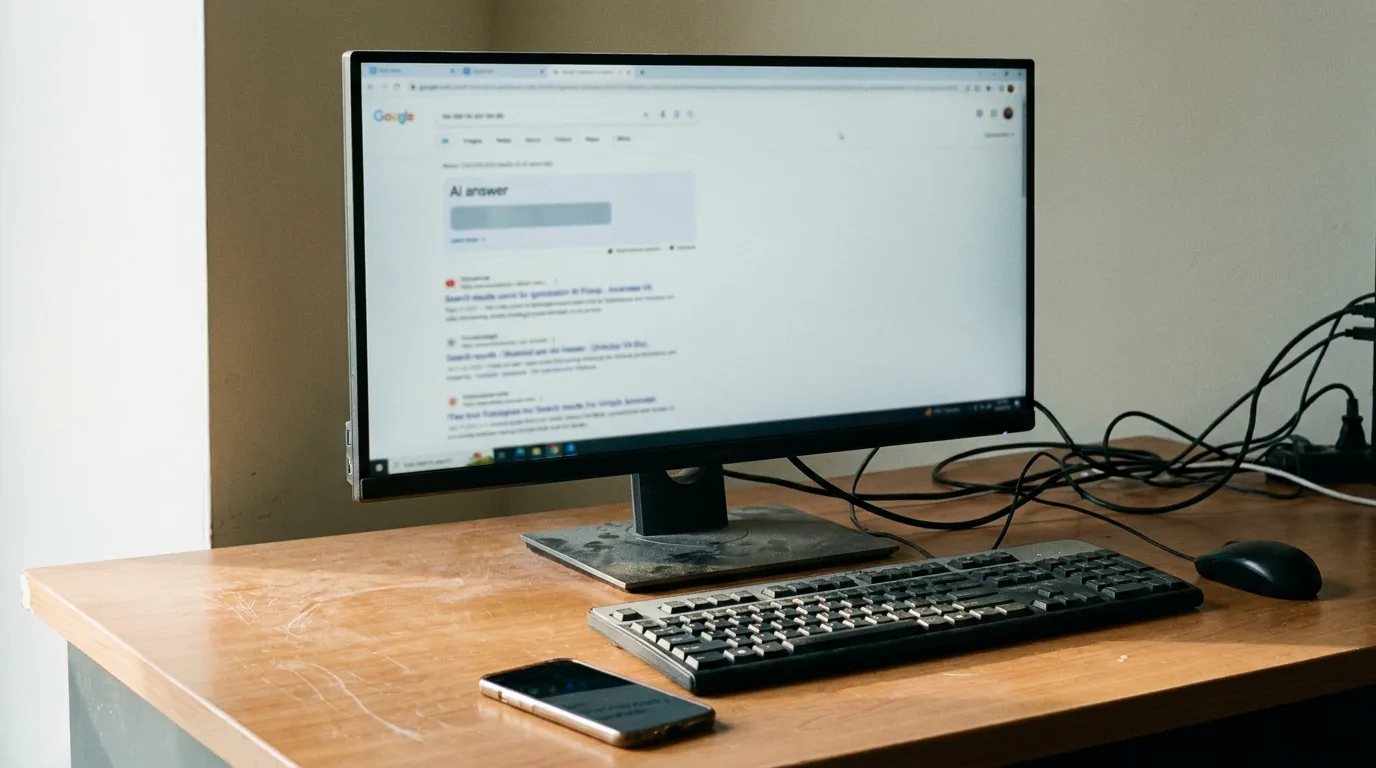
Quick answer: what it takes to get a home service page cited in AI Overviews
Make one service page easy for Google to extract and easy to attach to your business. According to Google Search Central, a page has to be indexed and eligible to appear in Search with a snippet before it can be shown in Google’s generative AI features, so ordinary Search eligibility is the gate. Plan on about a day of focused work per page, then 30 to 90 days of checking. What decides it is whether the page is crawlable, locally credible, and written so a machine can lift a complete answer without guessing.
AI Overviews began rolling out to everyone in the U.S. Google Search blog reports that on May 14, 2024, after Google said the feature had already been used billions of times in Search Labs.
| Step | Time |
|---|---|
| Make the page eligible for normal Search | 1 to 2 hours |
| Write the answer block and page structure | 1 hour |
| Add local proof and a dated job example | 2 to 3 hours |
| Make the business entity verifiable everywhere | 3 to 5 hours over a week |
| Reviews, photos and internal links | 30 minutes a week |
| Check the query set at day 30, 60 and 90 | 30 minutes a round |
Before you start: the materials, checks, and fit test
Gather the raw material first. Most owners already have it in a CRM or a phone camera roll and never put it on the site.
Materials checklist:
- One service page for the service you are targeting, not one page covering everything you do
- Your service area boundaries, including the travel or trip-charge cutoff
- Three to five recent job examples with dates, equipment or material details, and what you found
- Original photos from your own jobs, not stock
- Current license numbers, insurance, warranty terms and manufacturer certifications you can verify today
- Google Business Profile access, plus a list of every directory and review site that lists you
- Search Console access, including URL Inspection
The fit test. This method fits a page you can edit, on a site you can crawl, for a business whose public data you control. It does not fit two cases. If the page is one of forty city templates sharing the same 600 words with the city name swapped, those pages need a rebuild, not optimization. If your name, phone number or service area disagree across the site, the Business Profile and the top directories, clean the data first. Optimizing on top of conflicting information teaches Google to trust someone else.
Step 1: Make the page eligible for normal Google Search first
Start with eligibility, because nothing downstream matters if Google can’t fetch and render the page. Beyond the standard Search technical requirements there is no separate AI-only requirement, though a site does need to be included in Search generative AI features in Search Console.
Run these six checks and fix what fails:
- Crawlability: the page returns a 200 and robots.txt allows it
- Indexability: URL Inspection shows it indexed, with no noindex tag
- Canonical: one self-referencing canonical, not a pointer to a parent or duplicate
- Rendering: body copy, phone number and answer paragraph sit in the crawled HTML with JavaScript off
- Internal links: at least two, from navigation or a related service page
- Sitemap: the URL is in the XML sitemap and the sitemap is submitted in Search Console
Google’s AI answers draw supporting links from pages already eligible for Search, while ChatGPT runs its own crawler and index, so you’re working two layers at once. “GEO vs SEO for Home Services: What Actually Carries Over” covers what carries over, and “How to Show Up in ChatGPT Search for Home Services” covers the assistant side.
The mistake to avoid: paying for schema, an llms.txt file or an “AI version” of the page before the page is plainly eligible for ordinary Search.
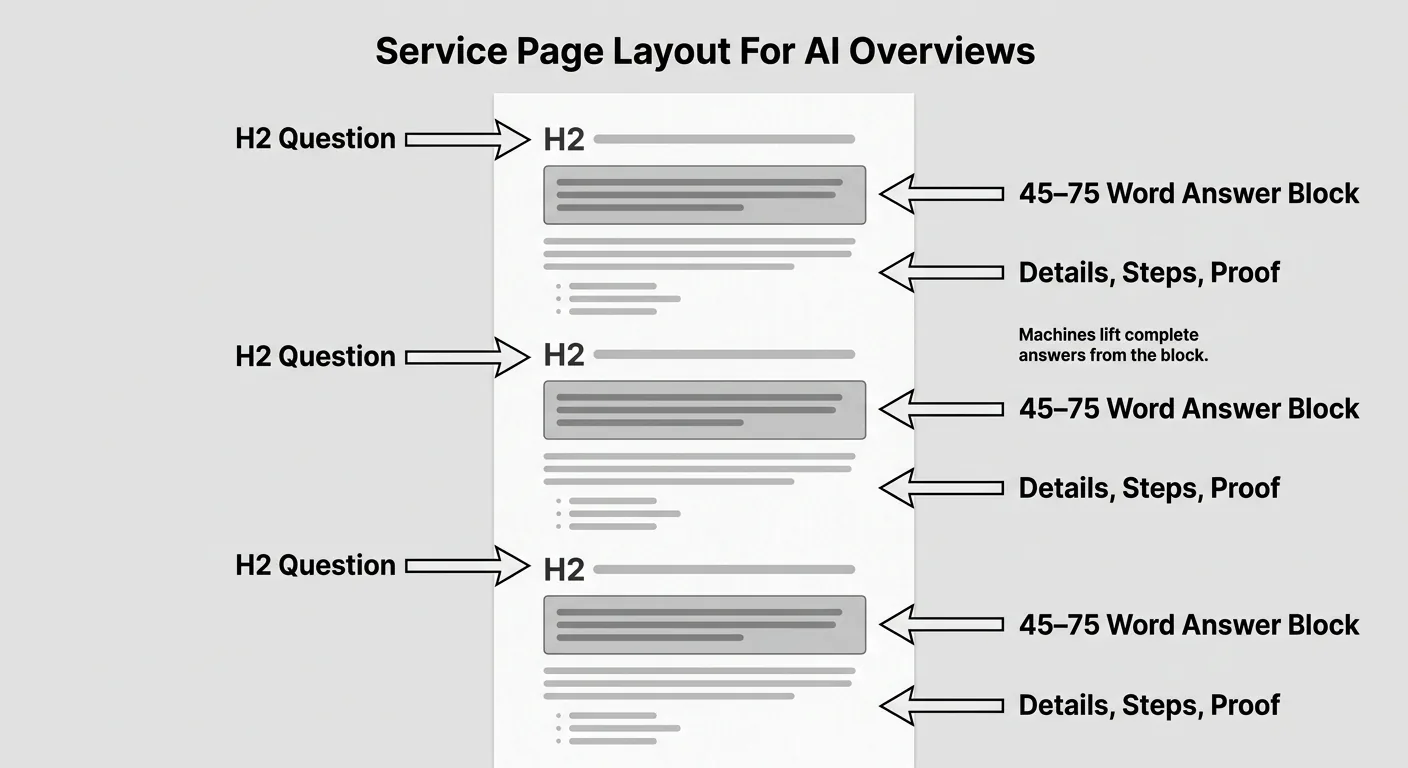
Pro tip: write an extractable answer block. Under each H2, put a 45 to 75 word direct answer before the explanation. The service, the condition it applies to, the rough time it takes, the stop point. Google breaks one question into several related searches, so a page that answers each variant in its own labeled passage gets pulled in more often than one long block.
Step 2: Add local proof that matches the service area and the job
Local proof means specifics only a company working in that market could write. Run this checklist on every service page and put the answers in the body text, not in a photo caption.
- Service-area specifics: the towns you cover, the response boundary, where the travel fee starts, and what you don’t cover
- Permit or inspection notes: the permit step for that work in your jurisdiction, who pulls it, and what it adds to the timeline
- Licensing and compliance: the license numbers, insurance and warranty terms that apply to that trade in that state
- Property type: the building stock you work on, such as 1970s slab ranches, three-story walkups or light commercial rooftops
- Seasonal condition: the local condition that drives the call, such as the first hard freeze, monsoon season or ice dams
- A dated job example: month and year, the symptom, the equipment or material named, what you found and what you did
When a city page helps and when it goes thin: a separate city page earns its place when it carries its own service area detail, permit notes, property types and a dated local job. Swapping the city name into the same copy gives Google forty pages it has no reason to trust.
Order the page the way a tech sequences the job. Symptom, safety action, information to collect, the checks a homeowner can safely make, likely fault categories, the point to stop, professional diagnosis, repair or replacement, testing, warranty. Commercial work belongs on its own page, with response-time commitments, after-hours escalation and the documentation you hand over.
Our own client work follows the same rule. Precision Patch Pros, a drywall company, produced 26 leads, 22 proposals, 10 closes and $11,030 in sales from Google ads and organic in March 2026, over 36 percent of the month’s sales. Dated, specific and attributable is the shape a proof point should take on your page.
The mistake to avoid: writing the local section last, in generic language, after the service copy is finished. It reads like filler and matches nothing a homeowner types.
Step 3: Make the business entity easy to verify everywhere
Google has to be certain which business you are before it will name you. That certainty gets built outside your website, across every place your company name appears.
| Asset | What to get right | Common failure |
|---|---|---|
| Google Business Profile | Most specific primary category, accurate secondary categories, service list, service areas, hours and holiday hours, quote link | Generic category like “contractor” instead of “HVAC contractor” |
| NAP data | Identical legal or public name, one phone number, one address format everywhere | An old tracking number still live on three directories |
| Service areas | The same territory on the site and the profile | Profile claims six counties, site claims two |
| Third-party corroboration | Licensing board listings, chamber directories, manufacturer dealer pages, trade associations, BBB, Yelp, Angi | Only review sites, no independent verification |
| Structured data | LocalBusiness and Service markup that matches the visible text | Markup claims 24/7 service the page never mentions |
A service-area business with no public address can still be verified: hide the address on the profile and set the service areas to the same territory the site claims. Then collect corroboration you don’t control, such as the state licensing board listing, the chamber directory, manufacturer dealer pages and trade profiles, all naming the same company doing the same work in the same territory.
The mistake to avoid: cleaning up the website and leaving the directories alone. A contractor with a good site and four conflicting phone numbers gives Google a reason to name the competitor whose identity is easier to verify.
If you want a second set of eyes on those listings, tell us what you’re seeing on your own searches.
Step 4: Use reviews, photos, and internal links to strengthen citation confidence
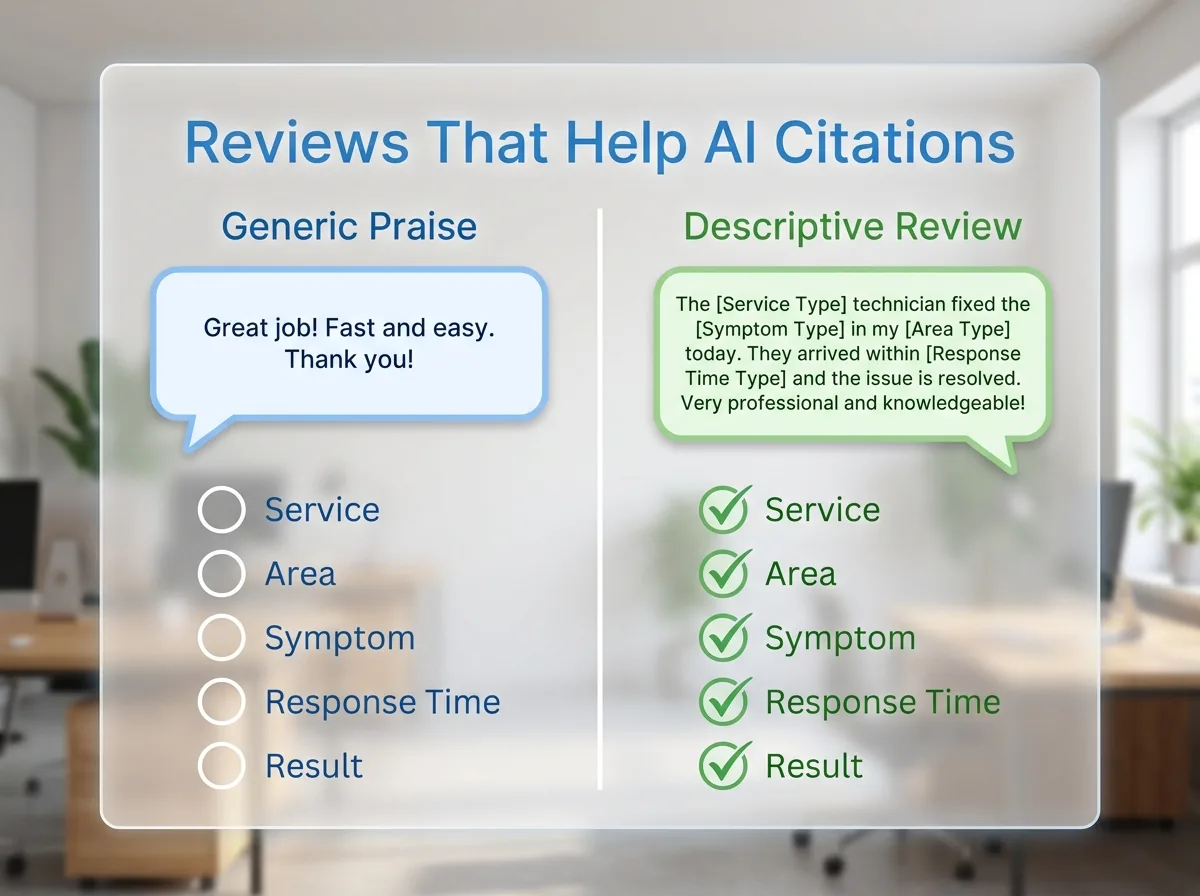
Treat reviews as four separate signals. Count and rating move map rankings. Recency tells Google the business is still active. Descriptive language is the one that supports a citation, because a review naming the service, the area, the symptom and the outcome corroborates what your page claims. Generic praise does not. “Great service” gives a machine nothing to match against.
A useful review names:
- The service performed, in plain words: “replaced the water heater,” not “did some plumbing”
- The location or general area, when the customer offers it naturally
- The condition or symptom that prompted the call
- Response time, especially for after-hours or emergency work
- The result, including anything the tech documented or explained
Ask every customer for honest feedback after the job. Never gate, script or incentivize. A steady trickle beats thirty reviews in one week followed by silence.
Original job photos with dates and captions in crawlable text beat stock images, because they show the work exists. Video helps, but the page still needs the explanation in text.
Internal links put the page inside a cluster instead of leaving it alone. Link it from navigation, from related service pages and from any article on the same problem. Outside mentions do the same job at a larger scale. Nobody publishes a backlink threshold for AI citation, but the pages that get named tend to be the ones an authority check already passes, which is why licensing directories, manufacturer pages and local coverage keep turning up as sources.
The mistake to avoid: buying reviews or links in bulk. Both break the corroboration you’re trying to build.
How to tell it worked
A good result looks like this: your company named in the AI answer for the searches that bring you jobs, and calls arriving on those searches. Score AI citation and organic rank as two separate numbers. Position doesn’t predict citation, and AI answers vary by person, location and phrasing, so the scoring is manual.
- Fix a query set. Fifteen to thirty searches: service plus city, symptom questions, and two or three branded searches. Don’t change the list between rounds.
- Run it at day 30, 60 and 90, from inside your service area, and screenshot every result, whether it names you or a competitor.
- Score citation frequency. The share of the query set where your company appears. Log your organic position for the same queries in a separate column.
- Read the downstream numbers on the same dates. Calls, quote requests, Google Business Profile actions, branded search volume in Search Console, and booked jobs from the CRM.
- Compare the two. Citation frequency up, with branded search and profile actions up in the same window, is the closest thing to proof while Google hides the clicks.
As Google Help notes, google says AI Overviews can and will make mistakes, so important information should be checked in more than one place. Check what the answer says about your hours and service area before you count the mention as a win, and remember that users can select the Web filter to see text links only, so part of your audience never sees the AI answer.
We use Search Share as the scoreboard, the share of Google’s four local result types (ads, map pack, organic results and AI answers) where a business shows up for the searches that bring it jobs. In our own work, map pack movement usually lands in 30 to 60 days and organic in 3 to 6 months, with no promised date on AI answers.
When to call a pro instead
DIY stops making sense at three points. First, technical indexation problems you can’t diagnose: rendering failures, canonical conflicts across a large site, or a migration that stranded half your pages. Second, multi-location data inconsistency across dozens of directories, where cleanup is a project rather than an afternoon. Third, schema that contradicts visible content site-wide.

Safety-sensitive content is its own line. Gas, electrical, structural and remediation pages need a named author or technical reviewer, dated updates, stated limits and clear stop conditions, because a homeowner can act on what they read.
Hired out, this work typically runs in the hundreds to low thousands of dollars a month for a single-location home service company, more when multi-location data needs cleanup.
If you want a read on which of the four Google surfaces you are missing, start with a conversation about your service area and current searches.
Frequently Asked Questions
Do I need to rank in the top 10 to get into an AI Overview, or can a page two result be cited?
Top-10 pages are cited most often, and one widely quoted analysis puts 92 percent of citations there, while local SEO practitioners report that only about 38 percent of local AI Overview citations sit in the top 10. Neither figure publishes its local query sample, so treat both as direction rather than a threshold. A contractor ranking eleventh with a complete Business Profile, descriptive recent reviews, and licensing-board corroboration can be named ahead of a fifth-place page with none of that. Track citation frequency across a fixed query set rather than assuming your rank position predicts it.
Does proximity matter less in Google AI Overviews than in the Local Pack?
Observational analyses suggest proximity correlates weakly with AI Overview citations, while the map pack still weighs relevance, distance, and prominence heavily. That’s a pattern, not a published Google rule. The practical takeaway: a well-corroborated regional contractor can be named outside its nearest ZIP codes, so authority and entity consistency deserve budget that pure address proximity can’t buy.
Why does Google’s AI Overview name my competitor when my roofing or HVAC page ranks higher?
Position is one input, and the answer also has to be sure who each business is and what it does. Audit the competitor source by source: Business Profile categories and service list, the wording of their recent reviews, the licensing and directory listings that name them, and any local coverage or forum threads that mention them. In most cases the gap is corroboration rather than page copy. Close that gap before you rewrite the page a third time.
Can I get into AI Overviews by posting on Reddit?
Community discussions do get cited, but promotional posting from a new account gets removed and can damage your reputation. If you participate, use an account with real history, answer technical questions without pitching, disclose that you own a company in the trade, and keep it to genuine help. Treat it as a slow reputation asset, never a placement tactic.
Should I spend money on schema, backlinks, videos, or review generation first?
For a home service company with a limited budget, the order is: fix technical eligibility and Business Profile completeness, then review generation, then local proof on service pages, then schema, then video and links. The first two cost the least labor and affect the most surfaces. Schema clarifies what already exists. It can’t rescue thin content or conflicting business data.
Do Google reviews help me get cited in AI answers, or do they only move map rankings?
Both, through different parts of the review. Read twenty of your recent reviews and mark how many name the actual job, the neighborhood and the result. A review that says “great service” adds a star and nothing a machine can match against your page.
Which schema types best support home service pages?
LocalBusiness with the specific subtype (Plumber, HVACBusiness, RoofingContractor, Electrician), Service with areaServed and provider, Organization, and BreadcrumbList cover most needs. Every property must match text a visitor can see on the page. Markup that claims hours, ratings, or coverage the page never states creates a trust problem instead of an advantage.
Researched and written with Sure Shot Cited, the AI article writer we built for our own client work, then reviewed by Ben Desjardins before it went live.