


White label SEO is SEO work done by one company and sold by another under its own name. Local SEO software sits right next to it: tools an agency can brand as its own to track map pack rankings, audit Google Business Profiles and send client reports. One is labor. The other is a dashboard. Most of the confusion in this market starts when buyers treat them as the same purchase.

What white label SEO means
Definition: White label SEO is an arrangement where a specialist provider performs SEO work, audits, content, technical fixes, local listings and reporting, and an agency sells that work to its own clients under its own brand. The agency owns the client relationship and the invoice. The provider stays behind the scenes.
Agency owners, freelancers, web designers and in-house marketers who buy SEO capacity instead of building it need to understand this model before they sign anything.
Two things about the definition trip people up. The defining feature is the rebranding. Exclusivity is a separate question. The same provider may run the same templates for dozens of agencies unless the contract says otherwise. What moves to the provider is the labor. Accountability stays put. When rankings drop, the client calls the agency whose logo is on the report.
How white label SEO works behind the scenes
The agency sells the work and owns the account. The fulfillment provider does the agreed tasks, and the agency reviews everything before the client sees it. In trade terms, the agency is the reseller and the client-of-record. The provider is the fulfillment provider or fulfillment partner.
A typical campaign runs in this order:
- Sale. The agency sets scope and price and signs the client under its own contract.
- Onboarding. The agency collects access to the website CMS, Google Analytics, Search Console and the Google Business Profile.
- Baseline audit. The provider checks crawlability, indexing, content, internal links, backlinks and local factors, then researches keywords.
- Strategy. The provider drafts a roadmap of keyword clusters, page priorities, technical fixes and local work.
- Execution. The approved work gets done: schema, speed fixes, service and location pages, profile updates, link outreach.
- Approval. The agency reviews, revises or rejects deliverables before anything goes live or reaches the client.
- Reporting. Rankings, organic traffic, conversions, completed tasks and next priorities go out under the agency’s brand, usually monthly.
The account ownership step deserves the most attention. The client should own the Google Business Profile and analytics accounts. The agency and provider get manager-level access, and that access comes off cleanly at the end.
Outsourcing also leaves the policy exposure with the client’s website. As Google Search Central notes, under Google’s spam policies, sites that break the rules may rank lower or drop out of results entirely, regardless of which vendor built the links.
White label SEO vs outsourced SEO, private label SEO, and SEO reseller services
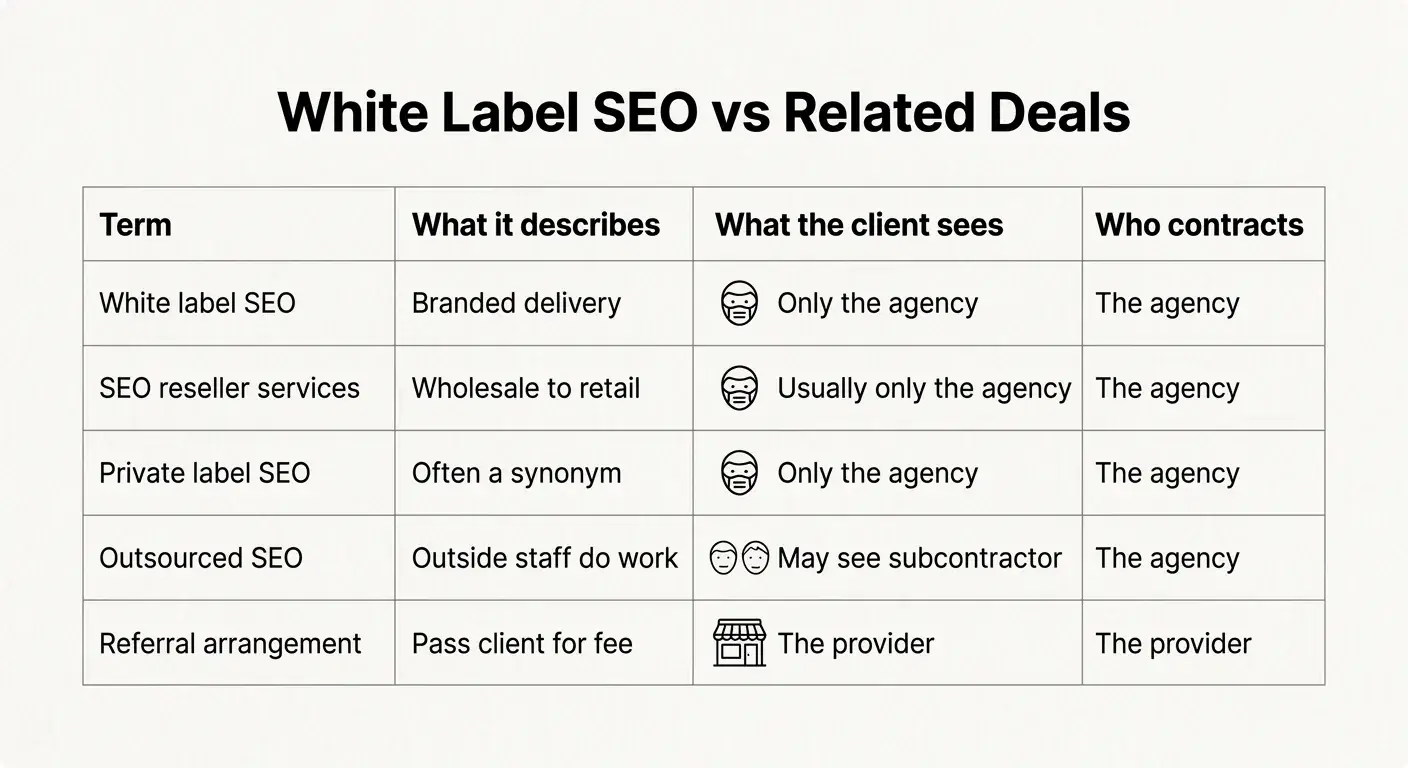
White label describes how the work is branded. Reseller describes how it is sold. Private label is the loosest of the three. Think of them as layers of one deal rather than competing products.
| Term | What it describes | What the client sees | Who contracts with the client |
|---|---|---|---|
| White label SEO | Branded delivery: reports, emails and dashboards carry the agency’s name | Only the agency | The agency |
| SEO reseller services | The commercial deal: buy at wholesale, sell at retail, keep the margin | Usually only the agency | The agency |
| Private label SEO | Often a synonym; some vendors use it for deeper customization or a branded system | Only the agency | The agency |
| Outsourced or subcontracted SEO | Any arrangement where outside staff do the work, branded or not | May see the subcontractor | The agency |
| Referral arrangement | The agency passes the client along for a commission | The SEO provider | The provider |
The referral row is the one that matters most. If the provider signs, invoices and talks to the client, the agency has sold a lead and kept a commission. That’s a different business with a different relationship.
Vendors blur these labels freely, and no industry body enforces them. A white label SEO reseller program and a “private label” offer can be identical behind the sales page. Read the scope of work and the contract. Ignore the name on the package.
When white label SEO matters for an agency
Yes, white label SEO can suit a web design or PPC agency with no in-house SEO staff, provided one person on the team understands SEO well enough to review the work. Without that person, the agency becomes a middleman who can’t defend the deliverables it sends.
The model earns its place in a few specific situations:
- A client asks for SEO you don’t offer. A web design firm finishes a site build and the client wants ongoing search work. Fulfillment lets the agency say yes without hiring a writer, a technical specialist and a link builder.
- The work has to stay under your brand. Agencies that sell on relationships don’t want a second vendor emailing their clients.
- Your book of accounts is growing faster than your hiring. Month-to-month fulfillment absorbs new clients without a salary commitment, though contract terms vary by provider.
- Clients sit in regulated or high-trust trades. Law, healthcare and finance clients need an approval step before any claim, page or link goes live. Fulfillment works here only if the provider accepts that review.
On white label SEO pricing, the math is wider than wholesale versus retail. According to Semrush, most businesses budget roughly $500 to $10,000 per month for an SEO retainer, per its 2023 white label SEO guide. The margin inside that number shrinks once account management, revisions, sales time, support and the occasional cleanup of a bad deliverable come out of it.
White-label local SEO software: what it is and what it is not
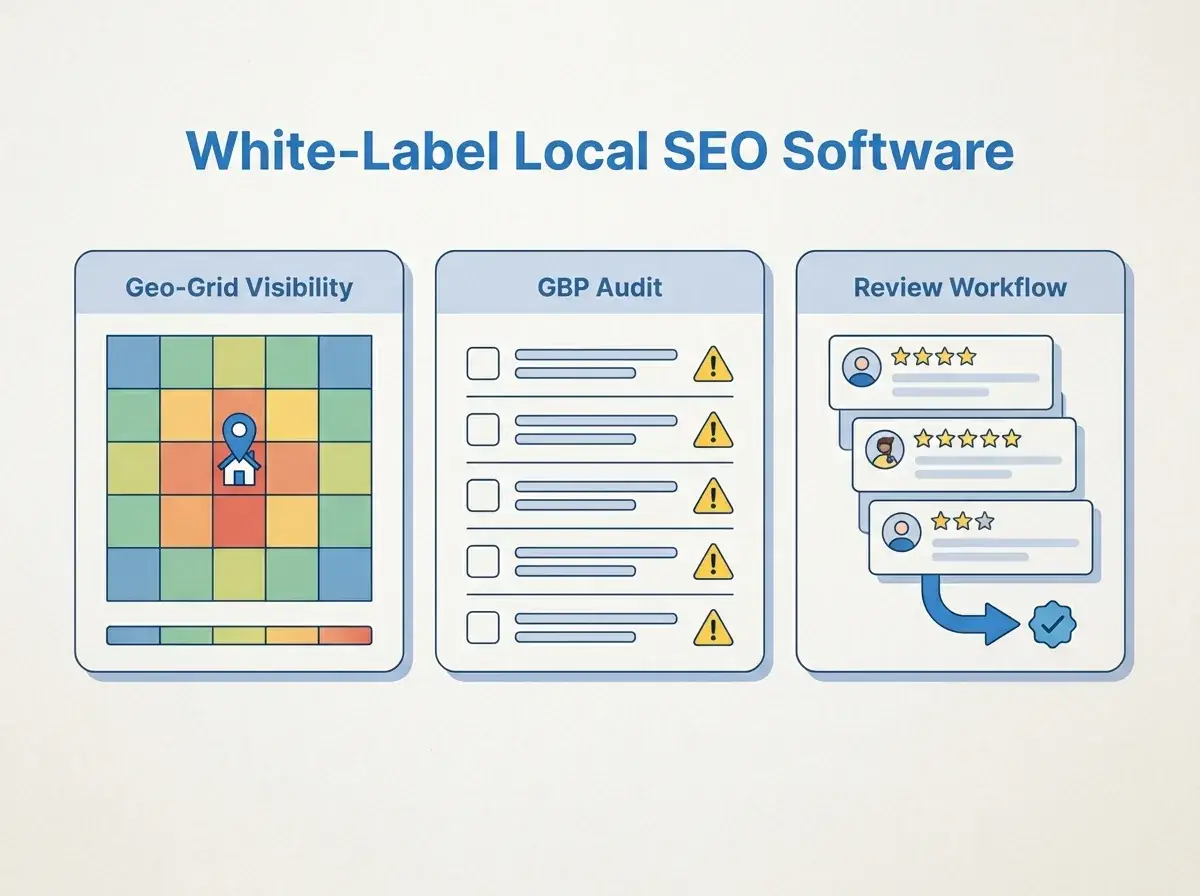
White-label local SEO software is an agency-facing subscription tool that tracks, audits, reports on and helps manage local search, presented under the agency’s brand. It does the measuring. The optimization still needs a person. White-label SEO services supply that person. The software supplies the instruments.
A few distinctions separate a useful platform from a branded spreadsheet:
Branded report or branded portal. Some plans put your logo on a PDF. Others give clients a portal on your own domain with your email sending address. Vendor names can still leak through URLs, support tickets and billing.
Monitoring or editing. Citation monitoring finds wrong names, addresses and phone numbers across directories. Citation building fixes them. Ask which one the platform does, and whether its distribution can create new duplicates.
One rank or a geo-grid. A single citywide position hides the truth. A geo-grid checks rankings from many points, showing a business that wins near its shop and vanishes ten miles out.
Service-area rules. Home service companies travel to customers, so software that auto-builds location listings can break Google’s rules. Whitespark reports that as a rule of thumb, Google wants a service area to reach no further than about two hours’ driving time from the base of operations.
Reviews as a workflow. Freshness matters to buyers. BrightLocal‘s 2026 survey found 74% of consumers only care about reviews written in the last three months. Good software flags new reviews, routes replies for approval and keeps an audit trail.
Example box: a small agency running both layers
A five-person agency serves eight HVAC and plumbing companies in a mid-size metro. It uses a white-label platform for geo-grid tracking across each service area, review alerts and a branded monthly portal. A contract specialist handles the human work: Google Business Profile fixes, service pages and citation cleanup. The agency’s account lead approves every change and sets expectations with ranges. At Sure Shot Systems, the LDC Framework’s typical timing is first Google Ads calls in week one, map pack movement in 30 to 60 days, organic in 3 to 6 months, and AI answers with no promised date. Ranges, not promises. The portal shows whether the map pack is actually moving. It never moves the map pack itself.
If you want a second opinion on how your tracking is set up, talk it through with us.
What to do next if you are evaluating a provider or platform
Decide first whether you’re buying software, fulfillment or both, then get every answer below in writing before you sign. Most bad white label relationships fail on control and ownership, rarely on features.
- Ownership. The client keeps the Google Business Profile, analytics and Search Console. Content, reports and campaign history belong to you or the client, never the vendor.
- Branding depth. Logo on a PDF, custom-domain portal, branded email, support identity. Know which you’re getting.
- Who does each task. A written list covering setup, profile work, citations, content, links, fixes and client communication.
- Approval workflow. Nothing publishes, no review reply posts, no link is placed without your sign-off.
- Non-solicitation. The provider never contacts your clients directly.
- Support. Response times, escalation path, and who handles a failed sync or a suspended profile.
- Data portability. Full export of rank history and reports, and what happens to dashboards when you cancel.
For a side-by-side of the platforms themselves, the full comparison is in “best local seo tools.”
If your team handles fulfillment and needs the measurement layer, Sure Shot Systems builds the Sure Shot Local Rank Tracker for local SEO agencies, freelancers and in-house marketers, on our own software, with a 60-day prove-it refund. Book a short call with Sure Shot Systems and we’ll look at your current setup and tell you plainly whether the tracker fits it.

Frequently Asked Questions
Does the client know a third-party SEO provider is involved?
Usually not. The client agreement decides whether that’s acceptable. Check whether your contract allows subcontracting and whether confidentiality covers the provider. Keeping the provider invisible is a branding choice. Quality and accountability depend on your review process, so many agencies disclose that they use specialist partners without naming them.
Can a white label provider access Google Search Console, Analytics and the Business Profile?
Yes, and most campaigns need it. Grant manager or user-level access through each platform’s own permission settings instead of sharing logins.
What is the difference between local rank tracking, geo-grid tracking and map pack monitoring?
Local rank tracking checks a keyword’s position from one set location. Geo-grid tracking runs that check from many points across a service area, often 25 or more, and maps the results. Map pack monitoring watches only the three-business local block. A plumber can rank first downtown and miss the map pack in the suburbs.
What happens to dashboards and ranking history if I switch software vendors?
It depends on the export terms. Some platforms export full rank history as CSV files. Others keep only the last few months or lock old scans inside the account. Before signing, run a test export. Without one, years of before-and-after data can disappear when you cancel.
Does local SEO still work?
Yes. Homeowners still search, read reviews and call from the map pack. In BrightLocal’s 2026 survey, 97% of consumers read reviews for local businesses. What changed is the number of places to show up: ads, the map pack, organic results and AI answers now share the same results page.
Is SEO dead now with AI?
No. AI Overviews and AI Mode pull from the same web content and business data that SEO already shapes, and Google’s spam policies now cover those AI features too. Nobody controls when an AI answer names a business. Clear service pages, a complete Google Business Profile and fresh reviews make it likelier.
What are the best local SEO tools?
The right tool depends on whether you need tracking, listings management, review workflows or a full client portal, and on how many locations you manage. A single-location shop and a 25-location franchise need different setups. The full comparison is in “best local seo tools.”
Researched and written with Sure Shot Cited, the AI article writer we built for our own client work, then reviewed by Ben Desjardins before it went live.