


A homeowner standing under a dripping ceiling is not reading a 2,000 word buying guide. They are asking a phone, out loud or in a chat box, who can come today. That is the moment contractors have to win, and it changes what AI search optimization has to do for a plumbing, HVAC, roofing or remodeling company compared with a software brand or a law firm. The model has to identify your business, confirm you cover that address, confirm you handle that exact failure, and hand over a phone number that gets answered. Four things about contracting change the moves: emergency intent, hard service-area boundaries, residential versus commercial proof, and a booked job as the only result that counts.

What makes LLM SEO different for contractors
LLM SEO for a home service company is the work of making your business facts easy for large language models to find, verify and repeat when a homeowner or a property manager asks for a provider. Four things about contracting change that work: emergency intent compresses the decision to minutes, your service area is a dispatch boundary rather than a list of city names, residential and commercial buyers screen on different proof, and the only result that counts is a booked job. The same work goes by GEO (generative engine optimization), AEO (answer engine optimization) and LLMO. The labels differ. The tasks underneath them do not.
Two paths decide whether a model names you. Training data is fixed, months old and closed to edits, so you cannot write your way into it. Live retrieval is the search the model runs while it writes the answer. That is the path you can move this quarter. It fans one question out into several hidden searches, something like “emergency plumber,” “open now” and “reviews,” then builds the answer from what comes back. What wins those hidden searches is clarity. One page that states plainly what the service is, who it is for, where you dispatch and what happens next. Structure helps a system pull the facts, and the facts themselves earn the mention.
What that means in practice: emergency intent often converts at a substantially higher rate than planned service terms in reported local search analysis. The answer either names you with a callable number or it is useless to that buyer. Service area is a boundary, not a city name. You dispatch to real zip codes, not to every suburb a page mentions. AI systems infer coverage from your profiles and pages, and they infer wrong when you are vague. Residential and commercial buyers want different proof. A property manager screens for certificates of insurance, after-hours escalation and multi-site dispatch. A homeowner screens for trip charges and arrival windows. The conversion is a call, not a click. Visibility that never reaches dispatch is a vanity metric.
The contractor LLM SEO plan at a glance
Run the moves in this order. Each one feeds the next, and each one has a result you can see on the job board.
- Lock your business facts. Effort: about a week, mostly admin. Impact: high. Result: AI answers that match your real dispatch area instead of guessing it.
- Rebuild the five service pages that sell. Effort: roughly a day a page. Impact: high. Result: more qualified calls and fewer mismatched ones.
- Earn service-specific reviews and third-party proof. Effort: ongoing, a few minutes per closed job. Impact: the highest of the five for getting recommended. Result: a better booked-job rate, because the buyer arrives already convinced.
- Make every call trackable before you chase mentions. Effort: half a day. Impact: medium now, high the moment you have to decide where the next dollar goes. Result: you can tell an AI-sourced call from a map pack call.
- Score visibility against booked jobs every week. Effort: an hour a week. Impact: medium. Result: tracked AI mentions sitting next to leads, booked jobs and revenue in one report.
We score step five with Search Share, the percentage of Google’s four local result types, ads, map pack, organic results and AI answers, where a business shows up for the searches that bring it jobs across its service area.
Key takeaway: steps one through three decide whether a model can recommend you. Steps four and five decide whether you can tell that it did.
Fix your business facts before you chase AI mentions
AI systems cross-check your website against your Google Business Profile, directories, review sites and licensing records, then trust whatever agrees. When those sources disagree, the system picks the wrong version or skips you for a contractor whose data lines up.
Build one source of truth in a single document, then push it everywhere. Legal name, spelled exactly as it reads on the license and the bank account. The phone number a person answers, plus the after-hours path. Service area by county and zip code, not a list of city names. Hours, including whether after-hours means answering or actual dispatch. State license numbers, plus bonding and insurance details. Service categories in the words buyers use, with the trades you do not cover left off.
Start with the four lines a model needs to hand a buyer to you: legal name, the number a person answers, the real dispatch area, and what happens after someone reaches out. Ours reads: Sure Shot Systems LLC, 651-368-9965 where Ben picks up, home service companies across the United States, and a form sent before noon Eastern on a business day gets a callback from Ben the same day. Four lines, identical in every place they appear, and nothing is left for a system to guess.
Align that record on the site footer, every service page, Google Business Profile, Apple Business Connect, Bing Places, Yelp, Angi, Houzz, the BBB listing, your trade association roster and your manufacturer dealer page. A branch you closed or moved keeps producing wrong recommendations for months when the old listing stays live, so kill it at the source. A “24/7” claim on a page while the profile shows 8 to 5 teaches every system that one of your claims is unreliable.
Build service pages that answer the right job, not just the keyword
A service page needs six things before a stranger could dispatch from it: what the service is, which equipment and property types you handle, the symptoms that trigger the call, what the visit involves, what happens next, and verifiable facts about who you are. A page built as a keyword container hands over one of the six.
Here’s what works: symptom to service. “Water heater leaking from the base” belongs on the page, not just “water heater repair.” Equipment and property specifics. Brands you service, panel types, roof systems, crawl space or attic access, condominium and multifamily work. Exclusions. What you do not do prevents mismatched leads and tells a model where your boundary sits. Emergency language with no ambiguity. After-hours answering, same-day appointment and 24-hour dispatch are three different promises. Publish the true one. The next step. Phone number first, then the information to have ready.
Keep each answer self-contained under its own heading, forty to seventy words, so a system can lift it without the paragraph above it.
Example: a residential water heater repair page
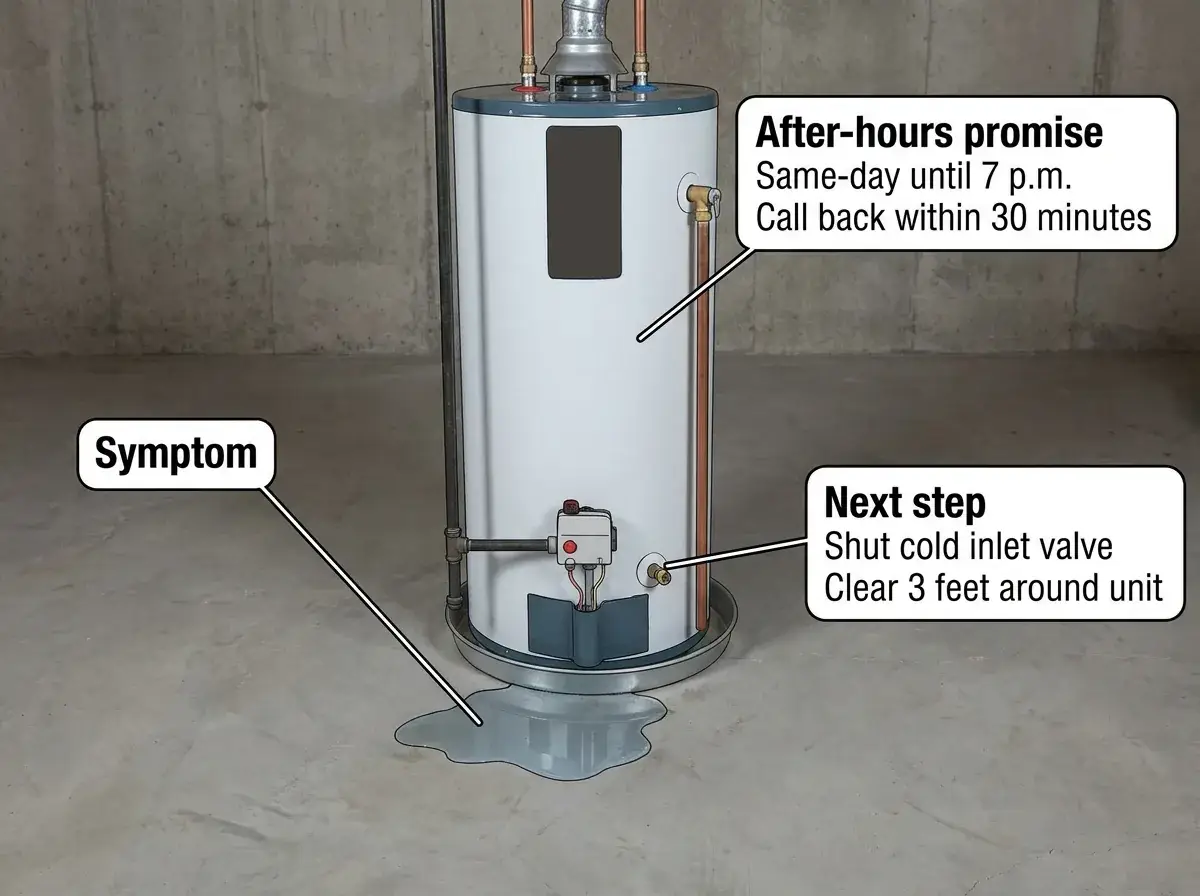
Ok, so. Symptom to service heading: “Water heater leaking from the base: same-day repair across the counties you serve.” Symptom block: water pooling at the tank, no hot water, or a relief valve that keeps opening, with what each one tends to mean. Exclusion: no well pump work, no commercial boilers, no mobile home units. Emergency status: leaking tanks dispatched same day until 7 p.m. and after that a live person answers and the on-call tech calls back within 30 minutes. Next step: the phone number, then shut the cold inlet valve, clear three feet around the unit, and have the brand, model number and age of the unit ready for the call.
Short pages that answer directly beat long pages that circle the subject. Extra prose buries the facts a model is trying to pull, and it buries the phone number with them.
Prove trust with reviews, third-party mentions, and real credentials
Review count gets you past the credibility filter. Review quality decides whether a model can match you to the question. Twenty recent reviews that name the job and the town do more for a single-city contractor than a hundred that say “great guys” and stop in 2023. A line like “replaced our 20 year old panel in Bakersfield the same day” is text a system can match to “emergency electrician near me.”
Four things to watch, in order. Wording. The service and the city in the review text. That happens when the tech asks on site, right after the work passes inspection, rather than through a generic text days later. Recency. A steady trickle every week reads as a working company. A wall of reviews from two years ago reads as one that may be gone. Rating. Hold 4.5 or better, and respond to every review (including the bad ones) in language that repeats the service. Platform diversity. Google first, then the two platforms your buyers actually use, which is Yelp and Angi for some trades and Houzz or Nextdoor for others.
Outside your own site, the sources that carry weight are the ones a person could verify: your state contractor licensing board record, manufacturer authorized dealer listings, permit records at the municipal building department, and trade association rosters. A commercial HVAC company needs property manager proof, insurance certificates and reporting samples. A residential roofer needs storm work, permit history and warranty detail. If you want a second set of eyes on which of those you are missing, tell us what you are seeing and we will look at it with you.
Track whether AI search actually sends calls and jobs
Four pieces make the proof chain for an AI-generated lead: a tracking number, a required source field, a dispatch question and a CRM rule that carries the source to the invoice. Build the workflow once so dispatch can run it without thinking.
Tracking numbers. A distinct number on the website with dynamic number insertion, and your real number left on the Google Business Profile. A source field. One required “how did you hear about us” field on every form, with ChatGPT, AI answer and Google AI as options people will actually pick. A dispatch question. “What did you search before you called?” asked on every call and logged in one field, because many AI-named buyers type your company name into Google afterward and land as branded traffic. A CRM rule. The source carries from first touch to estimate to paid invoice, so you can report booked jobs by source instead of leads by source.
Watch your branded searches on the same report. When AI answers start naming you, more people type your company name into Google, and that branded lift feeds the profiles and reviews those systems read next time.
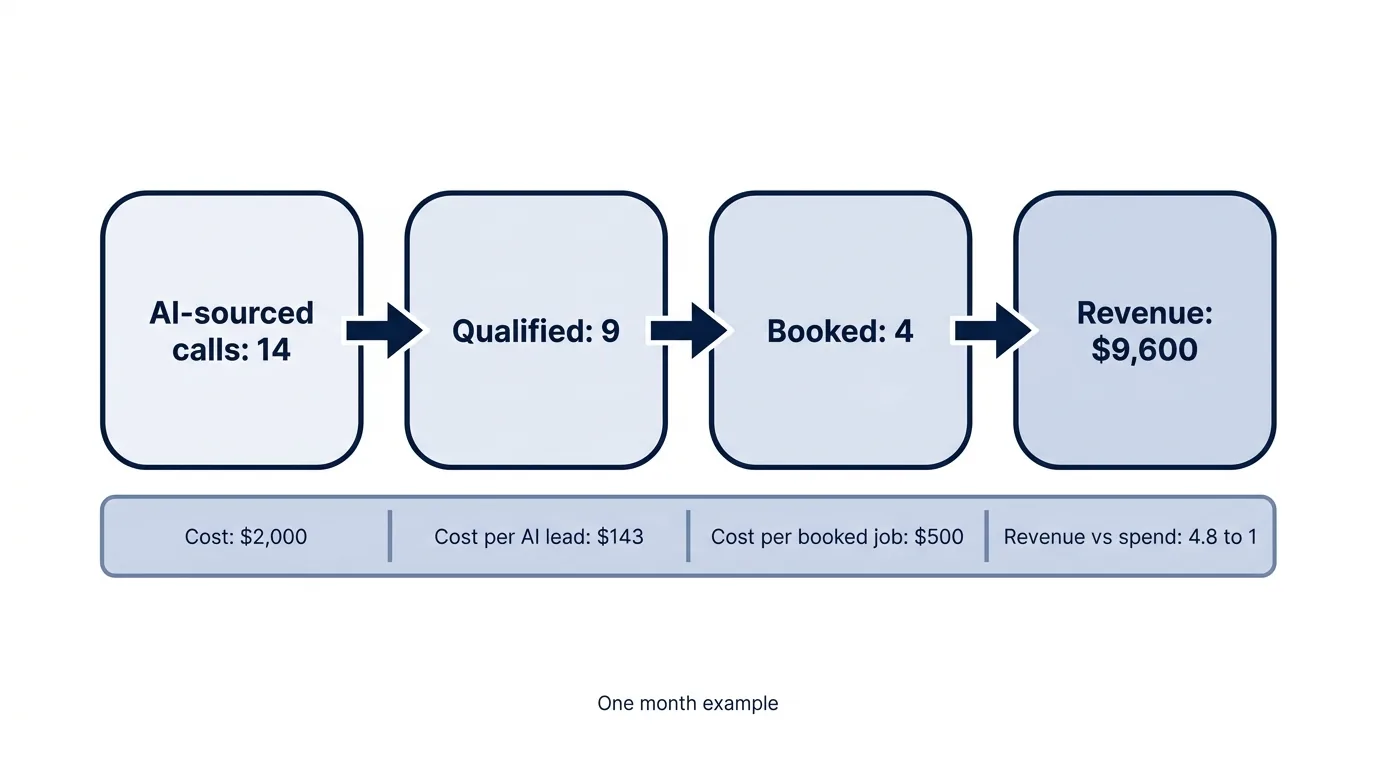
Then do the math monthly. Say a month produced 14 AI-sourced calls, 9 of them qualified, 4 booked, and $9,600 in revenue. The work behind them (listing cleanup, two page rebuilds and the review push) cost $2,000 that month. Cost per AI lead: $143. Cost per booked job: $500. Revenue against spend: 4.8 to 1. Now you can compare that line against the map pack and paid search instead of arguing about mentions.
That is the shape of the report we want for every channel. At Precision Patch Pros, a drywall company in Bakersfield, the first paid click after the February 2026 Google Ads rebuild cost $1.94 on February 18, 2026, and that lead closed the next day for $2,915. Mentions in an AI answer are an input. Booked jobs are the scoreboard.
Which technical fixes matter first: schema, llms.txt, or something else?
Schema markup and an llms.txt file will not make ChatGPT recommend you. Sort the technical work into three buckets and the order sorts itself. Eligibility is whether a system can reach, crawl and index your pages at all. Understanding is whether it reads your name, service area, services and credentials correctly. Recommendation is whether it has a reason to pick you over the contractor down the road. Crawl access and indexing decide eligibility, markup helps understanding, and nothing in the published evidence shows either one causes recommendation.
Rank the work by effort against impact and run the top rows first. Every row below a blocked crawler is wasted work.
| Fix | Effort | Impact | What it decides |
|---|---|---|---|
| Allow AI crawlers in robots.txt | 1 hour | High | Eligibility. Block them and nothing else counts |
| Verify in Bing Webmaster Tools and Google Search Console, submit the sitemap | 1 hour | High | Eligibility. Copilot and ChatGPT lean on Bing’s index |
| Fast mobile pages with one-tap calling | 1 day | High | Conversion, since emergency traffic is mostly mobile |
| LocalBusiness and Service schema with areaServed | 2 to 4 hours | Medium | Understanding |
| Freshness: dated updates to service pages each quarter | 2 hours a quarter | Medium | Understanding and retrieval |
| FAQPage and review markup | 2 hours | Low to medium | Understanding |
| llms.txt | 30 minutes | Unproven | Nothing measurable yet |
That is the whole baseline: crawlers allowed, the site verified and indexed in both Bing and Google, pages that load fast on a phone with a tappable number, and LocalBusiness plus Service schema that matches the facts written on the page. Everything after that is recommendation work, which means reviews, third-party proof and clear service facts. A correct read of a weak profile still loses to a contractor with recent service-specific reviews and a verifiable license.
Why one city shows up and another does not
Two causes look identical from the outside. Either you have a real coverage gap (meaning no page, no reviews and no listing proof tie you to that city), or the model simply answered differently this run, because these systems vary their output.
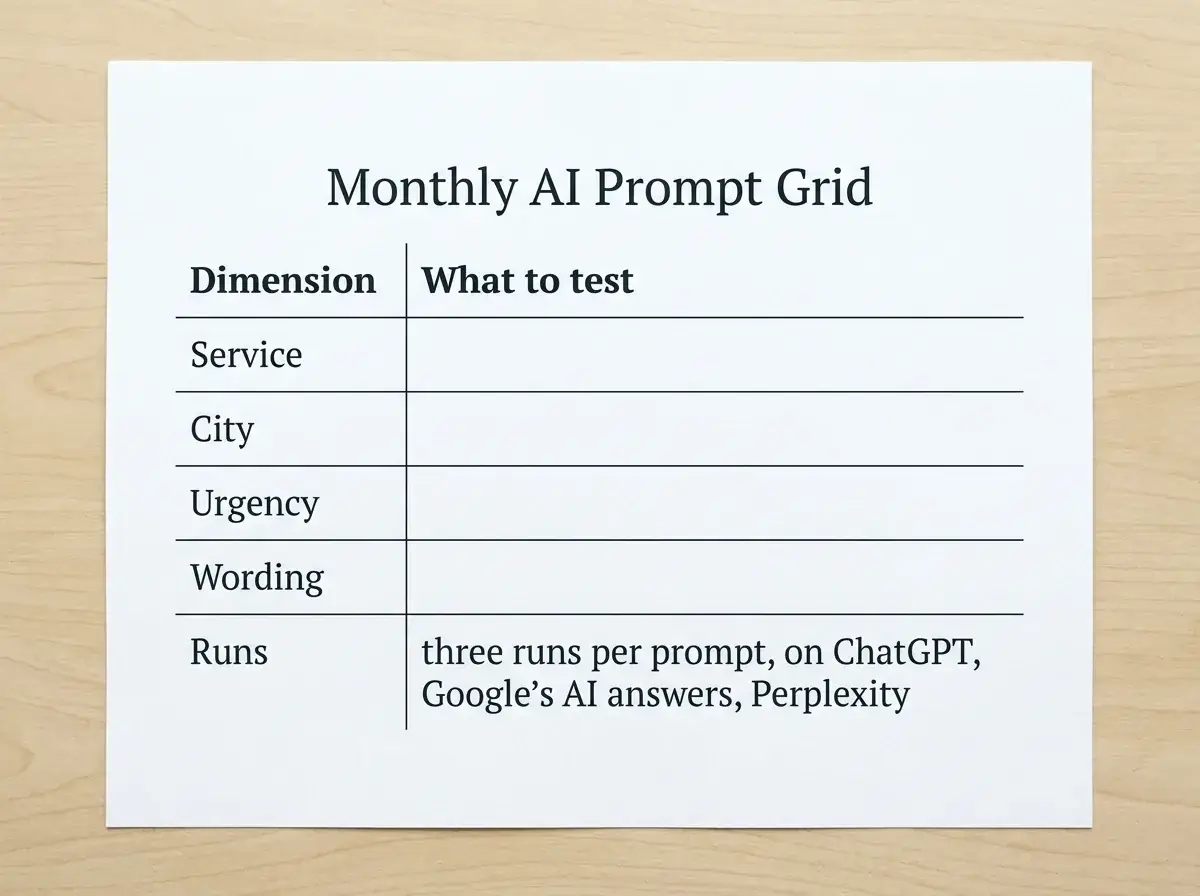
Separate them with a prompt grid you run the same way every month, across four dimensions: service, city, urgency and wording.
| Dimension | What to test |
|---|---|
| Service | your five highest-margin jobs, named the way buyers name them |
| City | five places you actually dispatch to, including the weak ones |
| Urgency | emergency tonight, same-day, planned replacement |
| Wording | comparative (“best plumber in X”), urgent (“emergency AC repair in X tonight”), symptom (“why is my furnace blowing cold air in X”) |
| Runs | three runs per prompt, on ChatGPT, Google’s AI answers and Perplexity |
Log the date, the platform, whether you were named and who else was. Read it this way: one miss in three runs on a prompt where you tend to show up is model variability, while zero mentions in nine runs for a city you dispatch to, across every wording and every urgency level, is a true coverage gap. The fix for a gap is local proof: real neighborhoods on the page, reviews from that city, and a listing that says you serve it.
For context, city-modified queries trigger AI Overviews less often than informational ones. One analysis found AI Overviews appeared on a relatively small share of searches containing a city or neighborhood name. So keep troubleshooting phrasing in the grid as well.
What to skip if you run a contracting business
Plenty of standard advice was written for businesses with long sales cycles and no dispatch board, and a fair share of what gets sold as AI SEO is ordinary SEO advice under a new label. Skip these.
Long general blog posts. A 2,000 word explainer on how a heat pump works rarely produces a call. A tight symptom page does. Hiding the phone number to push form fills. Emergency buyers call. Make the number tappable, sticky and above the fold. Chasing only high-volume keywords. “HVAC repair” in a metro is a bidding war. “No heat upstairs only” is a booked job. Seeding Reddit threads and paid listicles. Compliant posting means reading 50-plus threads, answering 3 to 5 questions a week and waiting 9 to 12 weeks before you mention the business, and moderators pull accounts that skip the disclosure. Few contracting offices have that time, which is why most agency Reddit advice ends in deleted posts. Scaling demand before you can answer it. More urgent calls than your office can pick up is a loss, not a win.
How long LLM SEO takes and what to expect
Milestones for a contractor starting from reasonably clean data:
Day 30: facts aligned everywhere, two or three service pages rebuilt, tracking numbers live, a baseline prompt grid logged.
Day 60: map pack movement, review wording shifting toward specific services and cities, first AI mentions on symptom and long-tail queries.
Day 90: measurable Search Share change, and AI-attributed calls in the CRM with close rates you can compare to other channels.
Those milestones sit on LDC Framework timing: first Google Ads calls in week one, map pack movement in 30 to 60 days, organic in 3 to 6 months, and AI answers with no promised date. They are typical ranges, not promises. Nobody controls when ChatGPT or Google’s AI answers name a business, so we do the work that makes it likelier and track it weekly.
What speeds it up: a bank of recent service-specific reviews, a verified Google Business Profile with real photos, and licensing records that match your legal name. What slows it down: duplicate or stale listings, a thin site with one page per trade, and a phone that goes to voicemail after five.
Start this week by putting your Google Business Profile, your state license record and your site footer side by side and fixing the first thing that disagrees. If you want the whole sequence run for your service area with a weekly written report and a monthly strategy call, start with a conversation about what is costing you the most right now.
Frequently asked questions
How to market a home service business?
Fix the problem costing you the most first, then work down the list. For most established contractors that order is open technician seats, past customers who bought once and disappeared, being findable on Google across ads, map pack, organic results and AI answers, and after-hours calls going to voicemail. Pick one, finish it, measure it, then move to the next.
Who is the best LLM SEO expert?
There is no ranked list worth trusting, so vet on evidence instead. Ask any candidate for a named client with dated lead and revenue numbers, ask who runs your account day to day, and ask what happens if the measure they promise does not move in 90 days. Month to month terms, stated prices, ad spend paid directly to Google with no markup, and client ownership of every account are the simplest filters.
Can a small contractor win AI visibility without hiring an agency to seed Reddit and listicles?
Yes, and the seeding is the first thing to drop. The work that moves AI answers is listing cleanup, five honest service pages, three to five new reviews a month and a monthly prompt grid, which runs about two hours a week once the first month of cleanup is done. Be careful with anyone selling placements in roundup posts or forum threads, because fabricated mentions get removed and they tie your name to pages you do not control.
Do AI recommendations send enough calls to justify moving budget out of Google Maps or paid search?
Not yet for most trades, and the honest answer is that nobody has published reliable lead volume figures by trade to settle it. Treat AI answers as a fourth surface you earn with work you are already doing for the map pack and organic results, not as a line item you fund by cutting what books jobs today. Compare cost per booked job by channel in your own CRM before shifting a dollar.
How to get AI to find your business?
Make yourself reachable first, then verifiable. Allow GPTBot, OAI-SearchBot and PerplexityBot in robots.txt, verify the site in Bing Webmaster Tools and Google Search Console, and claim the Google Business Profile with your real service area. Then make the legal name, phone number and license number identical on the site, the profile and the licensing board record. The platform-by-platform version is in “How to Show Up in ChatGPT Search for Home Services.”
What content should an emergency electrician publish that is useful without encouraging unsafe DIY work?
Publish the safety steps, then stop at the line where a license is required. A tripped breaker page can say reset the breaker once, stay away from a wet panel, and call 911 for a burning smell, then state plainly that panel replacements, aluminum wiring repairs and service upgrades need a licensed electrician and a permit from the local building department. That pattern reads as trustworthy to a homeowner and gives AI systems a clean, quotable answer that does not put anyone on a ladder.
Researched and written with Sure Shot Cited, the AI article writer we built for our own client work, then reviewed by Ben Desjardins before it went live.