


Google has no AI penalty. There is no switch in the ranking systems that looks at a page, decides a model wrote it, and drops the site. Google’s documented position is narrower than the myth: using automation, including generative AI, is a violation when the primary purpose is manipulating rankings. The risk sits with pages published at scale that add nothing a homeowner needed, whoever typed them.
The confusion makes sense. Google’s spam policies, its 2024 updates and a wave of forum posts about lost traffic all landed in the same two-year window. Three separate events got collapsed into one word: penalty. Ranking loss, deindexing and a manual action are different things with different evidence behind them. Only one of them is enforcement.

Why people think Google has an AI-content penalty
Three things fed the belief. As Google Search Central notes, Google announced in March 2024 that it expected its update and previous efforts to cut low-quality, unoriginal content in search results by 40%, and plenty of sites that had just started publishing AI drafts watched their traffic slide in the same weeks. Second, people started treating AI detection as enforcement. If a tool can tell a machine wrote it, surely Google can too, and surely it acts. Third, headlines blurred spam policy with ranking loss. “Violates the scaled content abuse policy” and “penalized for using ChatGPT” came to sound like the same sentence.
Correlation is not the same as causation here. Sites that publish thin pages fast get hit by quality updates whether a person or a model typed the words. It’s the pattern, not the pen.
Google does not punish AI content just for being AI
AI use by itself is not a violation. Google’s help page on AI-generated content answers the question head on: appropriate use of AI and automation is allowed, and the focus is content quality rather than how the content was produced. Automation, including generative AI, becomes spam when it is used primarily to manipulate search rankings.
Myth: Google scans for machine-written text and demotes it.
Fact: Google evaluates whether a page is helpful, original and trustworthy, and whether it was made mainly to game search. A model writing the first draft breaks no rule.
Three things follow from that wording.
- The policy turns on purpose rather than production method. Rewriting an AI-assisted page only to make it read human fixes nothing if the page still adds nothing. The audit worth running looks at usefulness, originality, accuracy and signs of manipulation.
- AI use earns no special gains. There is no bonus for using a model and no bonus for saying you did.
- Disclosure is a trust decision rather than a compliance shield. Google asks publishers to consider author bylines and to give readers background on how automation was used where that would help them. A disclaimer does not rescue a page that is inaccurate or built to capture rankings. Leaving the disclosure off does not trigger a penalty on its own.
The bar rises where errors hurt people. Google’s guidance singles out misinformation on health, civic and financial topics, so an invented statistic or a wrong code reference on those pages carries consequences past search.
Being eligible and being competitive are two different things. According to Semrush, one analysis of 42,000 blog posts found pages in position 1 had an 80.5% probability of being human-written, compared with roughly 10% for AI-generated pages. Semrush also reported that content classified as purely AI-generated held the top spot 9% of the time, while human-written content was there 80% of the time. So AI content is not banned. It loses more often, usually because the average unedited draft says what forty other pages already said.
What Google actually targets is scaled abuse and low-value pages
The target is scale without added value, no matter who produced it. Google’s own framing covers content made by automation, by humans, or by a combination of both. A team of writers churning out 300 near-identical city pages creates the same problem as a script that does it in an afternoon. By April 26, 2024, Google said the rollout had finished and that results showed 45% less low-quality, unoriginal content. Better than the 40% it had expected.
Picture a drywall contractor with 180 service-area pages. Each one swaps in the town name, the ZIP and the county. The other 600 words are identical. No page names a permit office, a job done in that town, a crew drive time or a price factor that differs there. That is doorway behavior even though every page passes a duplicate-content check, because the only variable is the search term.
| Publishing pattern | What it looks like on a home service site | How the policies treat it |
|---|---|---|
| Useful page with a reason to exist | A service-area page with local permit notes, job photos, crew response times and real pricing factors | Fine. Normal ranking rules apply |
| Thin template | The same 600 words with the city name, ZIP and a stock photo swapped | Low value. Often consolidated into one page by the ranking systems, or ignored |
| Manipulative bulk publishing | 200 pages from a keyword list that overlap by 90% or more, with no information unique to any one town, created only to capture searches | The scaled content abuse pattern. Pages need distinct intent and unique information, and without it deindexing or a manual action is possible |
Here is the decision rule. A town earns its own page when you can add at least three things that are true only there: a named job, a permit or inspection quirk, a response time, the housing stock, a photo set from that street. If you cannot, fold those towns into one service-area page that lists them and carries real detail about the work. Twelve pages that earn their keep beat 180 that repeat each other.
There is no safe percentage of AI text and no page count that is automatically fine. Risk tracks page purpose, originality, thinness, oversight and the pattern across the whole site. The practical test is not “did a model write this.” It is: would this page exist if search rankings did not exist?
AI can be used for SEO, but only when the result is useful
Yes, you can use AI across your search work. Outlining, first drafts, summarizing a long transcript, translating a service page into Spanish, cleaning up a review reply, pulling research together, checking which of your pages overlap. All of that is allowed when the published result meets Search Essentials and the spam policies like anything else you ship.
Can ChatGPT write SEO content? It can write the draft. It cannot know that your tech found knob-and-tube wiring behind three 1940s walls last month, or that your county inspector wants a separate permit for the same job your neighbor’s county waves through. That is the part that makes a page worth reading. It has to come from you.
Google’s guidance puts the review step before publication, not after it: fact-check and review AI-generated content for accuracy and trustworthiness while it is still a draft. If you want a second opinion on how your current pages read against that bar, tell us what you are publishing and we will look at it with you.

A traffic drop does not prove Google penalized your AI pages
A decline after you published AI drafts proves one thing: your traffic went down. Three different events get called a penalty, and each one leaves its own evidence in Search Console.
- Ranking loss. The pages are still indexed and still eligible, just outranked. Impressions and average position fall in the Performance report while the pages stay valid in the Pages report. This is the common outcome. It usually follows a core update or a stronger competitor.
- Deindexing. The pages are gone from the index. The Pages report names the reason: noindex, a canonical pointing elsewhere, a crawl error, or exclusion as a duplicate.
- Manual action. A human reviewer decided pages violate spam requirements. It shows up in the Manual Actions report with the affected scope named. No notice there means no manual action.
One independent study reported no clear relationship between how much AI-generated content a page contained and where it ranked. So run the short sequence before you blame the model. Compare the drop dates against published update dates. Check which templates lost and which held. Split the lost queries by class: branded, service plus city, and general questions. Confirm the pages are still indexed and that nothing broke technically. Then read the pages that took your spots and name what they carry that yours do not.
Timing matters too. New pages that have not ranked yet are not penalized pages. They are young. Being allowed to rank and being able to compete are two different things.
How much editing is enough to reduce risk
Grammar fixes are not enough. Neither is a rewrite that only changes the sentence rhythm so it reads less like a model. A fluent page with no obvious plagiarism can still carry fabricated facts, generic synthesis, unsupported claims and no reason to exist.
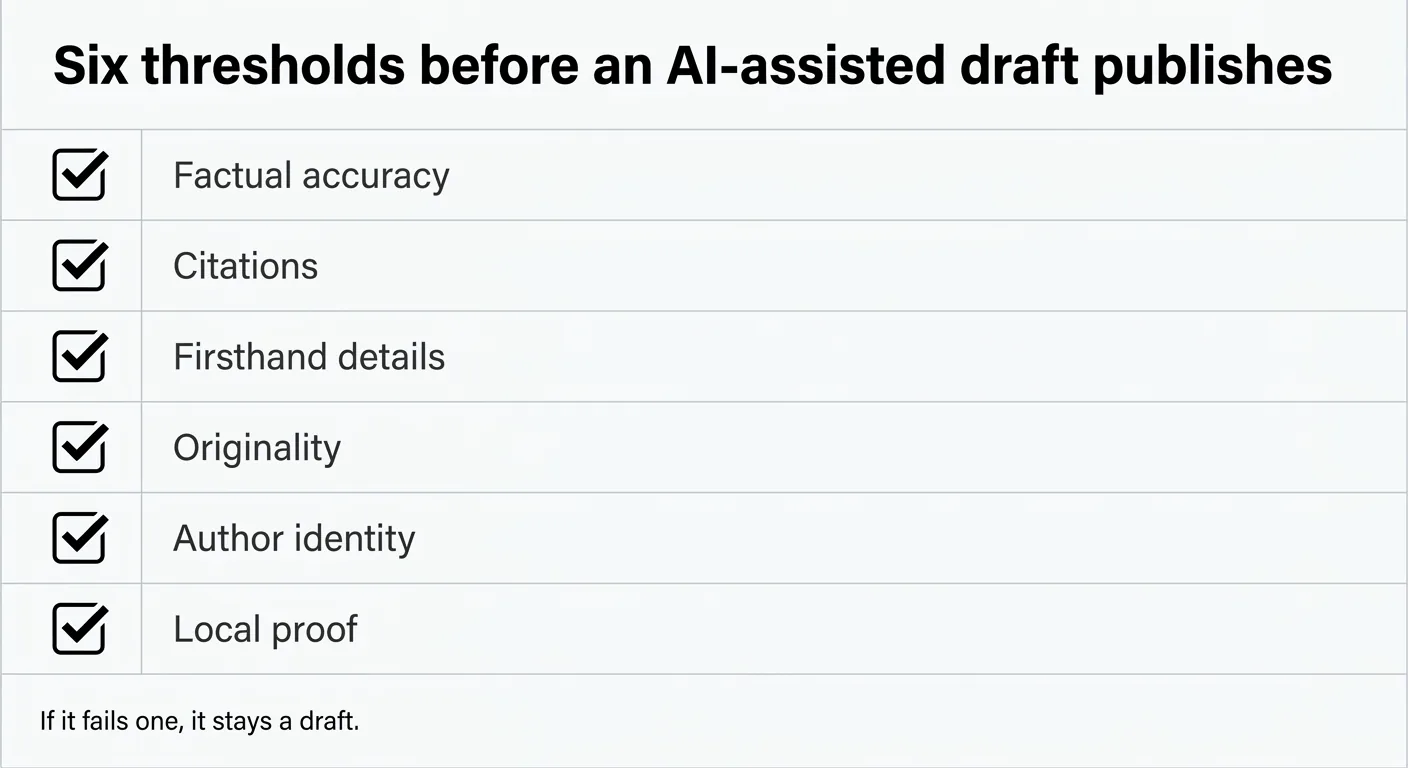
Six thresholds. A draft clears all six or it does not publish.
- Factual accuracy. Every number, code reference, date, brand name and specification checked against a real source. Models invent plausible citations.
- Citations. Claims about national standards, codes or statistics link to the body that published them, not to another blog.
- Firsthand details. Something from the job: what the repair involves in your market, what inspectors look for, what a homeowner should expect on day two.
- Originality. At least one section that is not already sitting on the first page of results.
- Author identity. A named person who read the page and would answer for it. A real employee name does not protect generic or fabricated content, so the byline has to sit on work that person actually contributed.
- Local proof. A photo from a job, a permit detail, a response time, a customer example tied to the service area.
Here is what a real review step catches that a grammar pass never will. A draft service page came back with a line promising the phone would be ringing in thirty days. Our own timing under the LDC Framework runs differently: first Google Ads calls in week one, map pack movement in 30 to 60 days, organic in 3 to 6 months, and AI answers with no promised date. Those are ranges, not promises. The claim got rewritten before the page went live.
First-hand detail is the half no tool can fake. When Sherman Burkhead, the owner of Precision Patch Pros, told me “These kind of leads are high closers and good margins,” that sentence came from his week, not from a prompt.
Then apply the decision rule. Ask whether the page would still exist if search rankings did not exist. If you would hand it to a homeowner who called you today, publish it. If the only reason it exists is a keyword, fix it or fold it into a page that earns its place.
AI detectors are not the standard Google uses
A detector shows one thing: a statistical guess that the wording looks machine-generated. It cannot show whether the page is accurate, whether it adds anything original, whether a reader got what they came for, or whether it was built to manipulate rankings. The guesses miss in both directions. Careful human writing gets flagged and heavily edited AI drafts pass clean. A detector score is not a safety metric.
Google’s stated concerns are a different list: usefulness, originality, accuracy and spam patterns. The quality standard behind that list is E-E-A-T. Experience is whether someone who has actually done the work had a hand in the page. Expertise is whether that person knows the trade. Authoritativeness is whether other people treat your company as a source for that work. Trustworthiness is whether the claims hold up when a reader checks them. The other three serve it.
This is where real money gets wasted. Owners pay to run drafts through humanizers until the meter reads green. The page still has no original information, no verified claims and no point of view of its own. The detector score moved. The risk did not. Judge the page on what a reader gets: a verified fact set, a local specific, a clear answer and a named person behind it.
What is actually true
Google does not penalize AI authorship. It acts on low-value, manipulative or deceptive content, whoever or whatever produced it. The March 2024 wording holds the distinction worth quoting: AI use is allowed, automation used primarily to manipulate rankings is not, and scale without added value is the real risk. The same rules reach the AI surfaces, so low-value pages aimed at AI Overviews or AI Mode get no exemption.
Pull your thinnest templates, run each page through the six thresholds above, and keep the ones that carry a real job, a real number and a real name. If you want a second set of eyes on which of your pages are earning their keep, book a strategy call and we will work through them together.
Frequently Asked Questions
Can I block AI content on Google?
You cannot filter AI-written results out of your own searches with a setting. What you can control is your own site: a robots.txt file and per-crawler rules decide which AI systems may read your pages, and you can refuse to publish machine drafts without review. Blocking crawlers like GPTBot keeps your content out of some AI training and answer sets, which is a tradeoff worth thinking through before you switch it on.
What is the 30% rule in AI?
The 30% rule is not in Google’s documentation. The idea circulates in forums as a shortcut, usually meaning “keep AI under 30% of a page.” A 100% AI draft with verified facts and real job detail can outperform a 20% AI page that says nothing new.
Does Google check for AI content?
Google does not publish an AI detector and has never said a machine-generated-text score triggers action. Its systems check how a page behaves: whether it is useful, original, accurate and free of scaled or manipulative publishing patterns. The one place a human decision shows up is the Manual Actions report in Search Console. Check there before you assume anything was flagged.
Does Google accept AI-generated content?
Yes, when the published page meets the same bar as anything else: verified facts, original information and a real reason to exist. Keep in mind that getting indexed is not approval. Indexing only means Google found and stored the page. Ranking systems reassess it with every update. Pages rejected across Google’s programs are almost always rejected for thin or duplicated content rather than for AI assistance.
Can AI write my Google Business Profile posts and review replies?
It can draft them, and that is where the approval step earns its keep. Two risks are specific to this channel: repetitive posts that read like a bot filled a calendar, and replies that confirm details of a job nobody on your team verified. Have the person who knows the customer read each reply before it posts, keep the specifics accurate, and vary the posts with real photos from recent work.
Researched and written with Sure Shot Cited, the AI article writer we built for our own client work, then reviewed by Ben Desjardins before it went live.